Would require the association to funds reserves in at least the minimum reserve contribution level as specified in the reserve study.
Current Status: Chaptered
FindHOALaw Quick Summary:
The Davis-Stirling Common Interest Development Act (“Act”) governs the management and operation of common interest developments, and requires an association to manage a common interest development, including requiring the association to levy regular and special assessments sufficient to perform its obligations, subject to specified limitations on increases in those assessments. The Act requires an association to distribute an annual budget report 30 to 90 days before the end of its fiscal year. Under existing law, that budget report includes, among other things, a summary of the association’s reserve accounts. The Act requires an association to perform a study of the reserve account requirements, and, as part of that study, cause to be conducted a visual inspection of the accessible areas of major components that the association is obligated to repair, replace, restore, or maintain.
This bill would, beginning January 1, 2032, amend Civil Code Section 5550 to revise the requirement to perform a study of the reserve account requirements to, among other things, include the minimum reserve contribution level to prevent the projected association reserve account balance from falling below zero over the following 30 years.
The bill would add Civil Code Section 5552 to require an association to fund the reserve account on an annual basis in at least the minimum reserve contribution level. If the association is unable to fund the reserve account in at least the minimum reserve contribution level without exceeding the above-described specified limitations on increases on assessments, then, notwithstanding those specified limitations, the bill would require the association to levy a reserve special assessment in an amount necessary to allow the association to fund to minimum contribution level without a reserve special assessment within 3 fiscal years, as provided.
**AB-2050 was signed into law on September 29, 2026, and takes effect January 1, 2027.
Would redefine a managing agent and limit the association’s ability to use reserve funds for litigation.
Current Status: Dead
FindHOALaw Quick Summary:
The Davis-Stirling Common Interest Development Act (“Act”), provides for the creation and regulation of common interest developments. Existing civil law defines an agent as one who represents another, called the principal, in dealings with third persons.
This bill would amend Civil Code Section 2295 to revise the above-described definition of agent to include a person or company that facilitates activities pursuant to specified provisions of the act and that is required to provide a fiduciary duty to the board of a homeowner’s association and its members.
Existing law defines “management services” for purposes of a common interest development to mean specified acts performed or offered to be performed in an advisory capacity for an association, including implementing provisions of governing documents for the operation of the common interest development.
This bill would amend Business & Professions Code 11500 to revise the above definition to specify that it means acts performed or offered to be performed by an agent, as defined above, in an advisory capacity for an association.
Existing law defines “professional association for common interest development managers” to mean an organization that meets specified criteria, including having at least 200 members or certificants who are common interest development managers in California.
This bill would amend Business & Professions Code 11500 to revise that definition to specify that it means an organization that employees an agent or agents, as defined, and that meets the above mentioned criteria.
Existing law requires the owner of a separate interest in a common interest development to provide specified documents to a prospective purchaser as soon as practicable before the transfer of title or execution of a real property sales contract, including a copy of all the governing documents for the association.
This bill would amend Civil Code Section 4525 to require the owner to provide additional information to a prospective purchaser, including, among other things, a separate disclosure regarding exterior elements and units requiring imminent repairs, if the association employs an association manager or management company.
Existing law prohibits the board of a common interest development from expending reserve funds for other than specified purposes, including repair, replacement, or maintenance of, or litigation involving major components, that the association is obligated to repair, replace, or maintain, and for which the reserve fund was established, subject to certain exceptions.
This bill would amend Civil Code Section 5510 to prohibit the board from expending reserve funds for other litigation, legal services, or to threaten litigation involving any real property owner of record or relative of the real property owner of record that is a member of the homeowner’s association.
The bill would make various other related and conforming changes to Civil Code Sections 5550, 5551, 5560, and 5565 regarding reserve studies and exterior elevated elements.
**AB-1238 was vetoed by the Governor on September 20, 2026.
Would repeal the board’s ability to review financial statements between meetings.
Current Status: Dead
FindHOALaw Quick Summary:
Existing law requires the board of directors of a nonprofit corporation or unincorporated association created for the purpose of managing a common interest development to, on a monthly basis, review specified documents, including account statements, reconciliations, and ledgers, unless the association’s governing documents impose more stringent standards. Existing law authorizes those review requirements to be met when every individual member of the board, or a subcommittee of the board consisting of the treasurer and at least one other board member, reviews the documents and statements independent of a board meeting, so long as the review is ratified at the board meeting subsequent to the review and that ratification is reflected in the minutes of that meeting.
This bill would repeal the provisions of Civil Code Section 5501 authorizing the review requirements to be met when individual members or a subcommittee of the board review the documents and statements independent of a board meeting as described above.
**SB-546 was gutted and amended on January 5, 2026, and no longer applies to common interest developments.
Would authorize a licensed civil engineer to conduct inspections of the exterior elevated elements, in addition to structural engineers and architects.
Current Status: Chaptered
FindHOALaw Quick Summary:
Existing law requires the board of a condominium association to cause a visual inspection to be conducted of the exterior elevated elements for which the association has maintenance or repair responsibility at least every 9 years. Existing law requires the inspection to be conducted by a licensed structural engineer or architect.
This bill would amend Civil Code Section 5551 to additionally authorize a licensed civil engineer to conduct the inspection.
This bill would declare that it is to take effect immediately as an urgency statute.
**AB-2114 was signed into law on July 15, 2024 and takes effect immediately.
(a) For purposes of this section, the following definitions apply:
(1) “Associated waterproofing systems” include flashings, membranes, coatings, and sealants that protect the load-bearing components of exterior elevated elements from exposure to water.
(2) “Exterior elevated elements” mean the load-bearing components together with their associated waterproofing system.
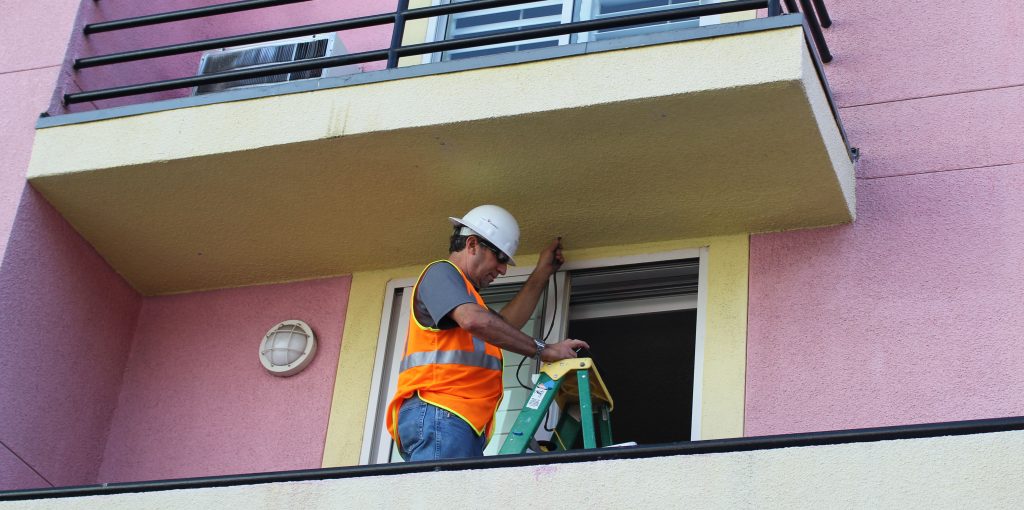
(3) “Load-bearing components” means those components that extend beyond the exterior walls of the building to deliver structural loads to the building from decks, balconies, stairways, walkways, and their railings, that have a walking surface elevated more than six feet above ground level, that are designed for human occupancy or use, and that are supported in whole or in substantial part by wood or wood-based products.
(4) “Statistically significant sample” means a sufficient number of units inspected to provide 95 percent confidence that the results from the sample are reflective of the whole, with a margin of error of no greater than plus or minus 5 percent.
(5) “Visual inspection” means inspection through the least intrusive method necessary to inspect load-bearing components, including visual observation only or visual observation in conjunction with, for example, the use of moisture meters, borescopes, or infrared technology.
(b)
(1) At least once every nine years, the board of an association of a condominium project shall cause a reasonably competent and diligent visual inspection to be conducted by a licensed structural or civil engineer or architect of a random and statistically significant sample of exterior elevated elements for which the association has maintenance or repair responsibility.
(2) The inspection shall determine whether the exterior elevated elements are in a generally safe condition and performing in accordance with applicable standards.
(c) Prior to conducting the first visual inspection, the inspector shall generate a random list of the locations of each type of exterior elevated element. The list shall include all exterior elevated elements for which the association has maintenance or repair responsibility. The list shall be provided to the association for future use.
(d) The inspector shall perform the visual inspections in accordance with the random list generated pursuant to subdivision (c). If during the visual inspection the inspector observes building conditions indicating that unintended water or water vapor has passed into the associated waterproofing system, thereby creating the potential for damage to the load-bearing components, then the inspector may conduct a further inspection. The inspector shall exercise their best professional judgment in determining the necessity, scope, and breadth of any further inspection.
(e) Based upon the inspector’s visual inspections, further inspection, and construction and materials expertise, the inspector shall issue a written report containing the following information:
(1) The identification of the building components comprising the load-bearing components and associated waterproofing system.
(2) The current physical condition of the load-bearing components and associated waterproofing system, including whether the condition presents an immediate threat to the health and safety of the residents.
(3) The expected future performance and remaining useful life of the load-bearing components and associated waterproofing system.
(4) Recommendations for any necessary repair or replacement of the load-bearing components and associated waterproofing system.
(5) On the first page of the report, all of the following:
(A) The date of inspection.
(B) The total number of units in the condominium project.
(C) The total number of units in the condominium project with exterior elevated elements.
(D) The total number of exterior elevated elements inspected pursuant to subdivision (b).
(F) As of the date of the inspection in subparagraph (A), the total number of inspected exterior elevated elements identified as posing an immediate threat to the safety of the occupants, pursuant to subdivision (g), and the number of units impacted.
(G) A certification that the inspector has conducted a visual inspection and evaluated a statistically significant sample of the exterior elevated elements within the condominium project, as required by subdivision (b).
(f) The report issued pursuant to subdivision (e) shall be stamped or signed by the inspector, presented to the board, and incorporated into the study required by Section 5550.
(g)
(1) If, after inspection of any exterior elevated element, the inspector advises that the exterior elevated element poses an immediate threat to the safety of the occupants, the inspector shall provide a copy of the inspection report to the association immediately upon completion of the report, and to the local code enforcement agency within 15 days of completion of the report. Upon receiving the report, the association shall take preventive measures immediately, including preventing occupant access to the exterior elevated element until repairs have been inspected and approved by the local enforcement agency.
(2) Local enforcement agencies shall have the ability to recover enforcement costs associated with the requirements of this section from the association.
(h) Each subsequent visual inspection conducted under this section shall commence with the next exterior elevated element identified on the random list and shall proceed in order through the list.
(i) The first inspection shall be completed by January 1, 2025, and then every nine years thereafter in coordination with the reserve study inspection pursuant to Section 5550. All written reports shall be maintained for two inspection cycles as records of the association.
(j)
(1) The association shall be responsible for complying with the requirements of this section.
(2) The continued and ongoing maintenance and repair of the load-bearing components and associated waterproofing systems in a safe, functional, and sanitary condition shall be the responsibility of the association as required by the association’s governing documents.
(k) The inspection of buildings for which a building permit application has been submitted on or after January 1, 2020, shall occur no later than six years following the issuance of a certificate of occupancy. The inspection shall otherwise comply with the provisions of this section.
(l) This section shall only apply to buildings containing three or more attached multifamily dwelling units.
(m) The association board may enact rules or bylaws imposing requirements greater than those imposed by this section.
(n) A local government or local enforcement agency may enact an ordinance or other rule imposing requirements greater than those imposed by this section.
All funds received by an association are deposited into the association’s operating account. A portion of those funds are then transferred into the association’s reserve account according to the association’s reserve funding plan.
Review Requirements
Included within the board’s financial review requirements is the review of information pertaining to the association’s operating account (i.e., review bank account statements, review current reconciliation of the operating account, etc.). (Civ. Code § 5500; See also “Financial Review Requirements.”)
Manager Deposits & Control of Account Civil Code Section 5380 contains several requirements governing how funds received by a managing agent on behalf of an association must be deposited into certain bank accounts. (See “Deposit of Association Funds by Manager.”)
Financial Transfers Requiring Written Board Authorization
Transfers from the association’s operating account over certain thresholds require written board authorization. (See “Financial Transfers Requiring Written Board Authorization.”)
Review the association’s most recent reserve study on an annual basis in order to consider and implement any necessary adjustments to the board’s analysis of the HOA’s reserve account requirements. (Civ. Code § 5550(a).)
Notwithstanding the above, the board has the duty to adhere to any more stringent financial review requirements that may be contained in the association’s governing documents. (Civ. Code § 5500.)
Financial Review by Board Independent of Board Meeting The financial review requirements of Section 5500 discussed above may be met when every individual member of the board, or a subcommittee of the board consisting of the treasurer and at least one other board member, reviews the documents and statements described in Section 5500 independent of a board meeting, so long as the review is ratified at the next board meeting and that ratification is reflected in the minutes of that meeting. (Civ. Code § 5501.)
An association’s “reserve account” means both of the following:
“Moneys that the board has identified for use to defray the future repair or replacement of, or additions to, those major components that the association is obligated to maintain.” (Civ. Code § 4177(a).)
“The funds received, and not yet expended or disposed of, from either a compensatory damage award or settlement to an association from any person for injuries to property, real or personal, arising from any construction or design defects.” (Civ. Code § 4177(b).)
The reserve account is thus separate and distinct from the association’s operating account that contains funds used to carry out the association’s day-to-day operations.
Withdrawal, Spending & Disclosure Requirements Boards are required to “exercise prudent fiscal management in maintaining the integrity of the reserve account.” (Civ. Code § 5515(e).) Failing to do so could not only jeopardize the financial viability of the association and the property values of its members, but could also constitute a breach of the board’s fiduciary duties. (Raven’s Cove Townhomes, Inc. v. Knuppe Dev. Co. (1981) 114 Cal.App.3d 783, 800-801.)
Associations are therefore subject to numerous statutory requirements that serve to:
Limit the purposes for which funds may be expended from the reserve account;
Regulate the procedure through which a board may authorize the temporary transfer (borrowing) of funds from the reserve account without the membership’s approval; and
Financial Transfers Requiring Written Board Authorization
Transfers from the association’s reserve account over certain thresholds require written board authorization. (See “Financial Transfers Requiring Written Board Authorization.”)
The health of a HOA’s reserve account is vital to protecting the financial viability of the association and the property values of its members. HOAs are therefore required to perform reserve studies, make various reserve disclosures, and are subject to limitations on the purposes for which funds may be expended from the reserve account.
Spending Restrictions A board may not spend reserve funds “for any purpose other than the repair, restoration, replacement, or maintenance of, or litigation involving the repair, restoration, replacement, or maintenance of, major components that the association is obligated to repair, restore, replace, or maintain and for which the reserve fund was established.” (Civ. Code § 5510(b).)
Exception: Temporary Transfer (Borrowing) of Reserve Funds Notwithstanding the above, a board may authorize the temporary transfer of funds from the reserve account to the association’s operating account in order to “meet short-term cash flow requirements or other expenses” without a vote of the membership. (Civ. Code § 5515(a).) The procedure through which the board may validly authorize such a transfer is subject to several requirements (i.e., provide notice of the intent to consider the transfer, issue a written finding as to why the transfer is needed and how the borrowed funds will be restored within one (1) year, etc.). (See “Borrowing Reserve Funds (Reserve Transfers).”)
Signature Requirement The withdrawal of funds from the reserve account requires the signatures of at least two (2) persons. Those persons must either both be directors, or one officer who is not a director and one director. (Civ. Code § 5510(a).)
The California Bureau of Real Estate (CalBRE) issued a warning in 2012 in response to a growing number of HOAs with inadequate reserve funds and the resulting problems encountered by those HOAs and their members (i.e., reduced maintenance capabilities, special assessment problems, declining property values, difficulties in securing loans, etc.). These concerns motivated the California Legislature to, in addition to the pre-existing obligation for HOAs to perform reserve studies, increase the number of disclosures HOAs must make on an annual basis regarding their reserve accounts.
Disclosures The required reserve disclosures are provided to the association’s membership as part of the association’s annual budget report that is prepared pursuant to Civil Code Section 5300, and include all of the following:
Reserve Funding Plan – a summary of the reserve funding plan adopted by the board pursuant to Civil Code Section 5550(b)(5). (Civ. Code § 5300(b)(3).) The reserve funding plan indicates the way in which the association will fund the required annual contribution to the reserve account, and includes a schedule of the date and amount of any increases in regular or special assessments that will be needed to sufficiently fund the reserve funding plan. (See “Reserve Funding Plan.”) The summary of the reserve funding plan must also include a notice to members that the full reserve funding plan is available upon request. (Civ. Code § 5300(b)(3).)
Deferred Maintenance Items – a statement as to whether the board has determined “to defer or not undertake repairs or replacement of any major component with a remaining life of 30 years or less, including a justification for the deferral or decision not to undertake the repairs or replacement.” (Civ. Code § 5300(b)(4).)
Anticipated Special Assessments – a statement as to whether the board, consistent with the reserve funding plan, “has determined or anticipates that the levy of one or more special assessments will be required to repair, replace, or restore any major component or to provide adequate reserves therefor. If so, the statement shall also set out the estimated amount, commencement date, and duration of the assessment.” (Civ. Code § 5300(b)(5).)
Reserve Funding Mechanisms – a statement as to the mechanism(s) by which the board will fund reserves to repair or replace major components, including assessments, borrowing, use of other assets, deferral of selected replacements or repairs, or alternative mechanisms. (Civ. Code § 5300(b)(6).)
Procedures for Calculation and Establishment of Reserves – a general statement addressing the procedures used for the calculation and establishment of those reserves to defray the future repair, replacements, or additions to those major components that the association is obligated to maintain. The statement must include, at the least, reserve calculations using the formula described in Civil Code Section 5570(b)(4), and may not assume a rate of return on cash reserves in excess of two percent (2%) above the discount rate published by the Federal Reserve Bank of San Francisco at the time the calculation was made. (Civ. Code § 5300(b)(7).)
Assessment and Reserve Funding Disclosure Summary form – the annual budget report (whether delivered in full or in summary form) must also be accompanied by the Assessment and Reserve Funding Disclosure Summary form that is prepared pursuant to Civil Code Section 5570. (Civ. Code § 5300(e).)
Disclosure Timeframe The above disclosures that are included within the annual budget report must be distributed to the association’s members within thirty (30) to ninety (90) days before the end of the association’s fiscal year, regardless of any provisions to the contrary contained in the association’s governing documents. (Civ. Code § 5300(a).)