

(a) On or after January 1, 1987, for public swimming pools in any common interest development, as defined in Section 4100 or 6534 of the Civil Code, that consists of fewer than 25 separate interests, as defined in Section 4185 or 6564 of the Civil Code, the person operating each pool open for use shall be required to keep a record of the information required by subdivision (a) of Section 65523 of Title 22 of the California Administrative Code, except that the information shall be recorded at least two times per week and at intervals no greater than four days apart.
(b) On or after January 1, 1987, any rule or regulation of the department that is in conflict with subdivision (a) is invalid.
Related Links
Increased Maintenance Requirements for HOA Pools in California – Published on HOA Lawyer Blog (10/31/15)
22 CCR Section 65523. Public Swimming Pools; Operation Records.
(a) Except as provided in Health and Safety Code, section 116048, the pool operator of every public pool open for use at a public pool site shall test the disinfectant residual and pH of the public pool water a minimum of once per day. The pool operator shall also test heated pools’ water temperature a minimum of once per day. The pool operator may perform these daily tests using a properly calibrated automatic chemical monitoring and control system if approved by the enforcing agent and in accordance with the manufacturer’s equipment specifications for calibration and directions for proper use. The pool operator shall maintain a written daily record of all test results, equipment readings, calibrations, and corrective action taken at the public pool site.
(b) If the pool operator adds cyanuric acid to a public pool, the pool operator shall measure the cyanuric acid concentration in that pool a minimum of once per month and shall maintain a written record of these test results and all corrective action taken at the public pool site.
(c) The pool operator shall test combined chlorine at a frequency required to maintain maximum combined chlorine concentrations below 0.4 ppm. The pool operator shall maintain a written record of these test results and all corrective action taken at the public pool site.
(d) The pool operator shall maintain a written record of routine maintenance and repairs to the public pool at the public pool site.
(e) If a fecal, vomit, blood contamination, near-drowning, or drowning incident occurs in a pool, the pool operator shall record the incident in accordance with the requirements of section 65546 and shall identify the affected public pool in the incident record if there is more than one pool at the public pool site. This record shall be maintained at the public pool site.
(f) The pool operator shall maintain data and records collected pursuant to subdivisions (a), (b), (c), (d), and (e) for at least two years for inspection by the enforcing agent and shall submit all data and records to the enforcing agent upon the agent’s request.
Note: Authority cited: Sections 116048, 116050 and 131200, Health and Safety Code. Reference: Sections 116035, 116040, 116043, 116050 and 116055, Health and Safety Code.
Current through 8/14/15 Register 2015, No. 33
Related Links
Increased Maintenance Requirements for HOA Pools in California – Published on HOA Lawyer Blog (10/31/15)
Health & Safety Code Section 116064.2. Public Swimming Pool Safety Devices.
(a) As used in this section, the following words have the following meanings:
(1) “ANSI/APSP performance standard” means a standard that is accredited by the American National Standards Institute (ANSI) and published by the Association of Pool and Spa Professionals (APSP).
(2) “ASME/ANSI performance standard” means a standard that is accredited by the American National Standards Institute and published by the American Society of Mechanical Engineers.
(3) “ASTM performance standard” means a standard that is developed and published by ASTM International.
(4) “Public swimming pool” means an outdoor or indoor structure, whether in-ground or above-ground, intended for swimming or recreational bathing, including a swimming pool, hot tub, spa, or nonportable wading pool, that is any of the following:
(A) Open to the public generally, whether for a fee or free of charge.
(B) Open exclusively to members of an organization and their guests, residents of a multiunit apartment building, apartment complex, residential real estate development, or other multifamily residential area, or patrons of a hotel or other public accommodations facility.
(C) Located on the premises of an athletic club, or public or private school.
(5) “Qualified individual” means a contractor who holds a current valid license issued by the State of California or a professional engineer licensed in the State of California who has experience working on public swimming pools.
(6) “Safety vacuum release system” means a vacuum release system that ceases operation of the pump, reverses the circulation flow, or otherwise provides a vacuum release at a suction outlet when a blockage is detected.
(7) “Skimmer equalizer line” means a suction outlet located below the waterline, typically on the side of the pool, and connected to the body of a skimmer that prevents air from being drawn into the pump if the water level drops below the skimmer weir. However, a skimmer equalizer line is not a suction outlet for purposes of subdivisions (c) and (d).
(8) “Suction outlet” means a fitting or fixture of a swimming pool that conducts water to a recirculating pump.
(9) “Unblockable suction outlet” means a suction outlet, including the sump, that has a perforated (open) area that cannot be shadowed by the area of the 18 inch by 23 inch Body Blocking Element of the ANSI/APSP-16 performance standard, and that the rated flow through any portion of the remaining open area cannot create a suction force in excess of the removal force values in Table 1 of that standard.
(b)
(1) Subject to subdivision (e), every public swimming pool shall be equipped with antientrapment devices or systems that comply with the ANSI/APSP-16 performance standard or successor standard designated by the federal Consumer Product Safety Commission.
(2) A public swimming pool that has a suction outlet in any location other than on the bottom of the pool shall be designed so that the recirculation system shall have the capacity to provide a complete turnover of pool water within the following time:
(A) One-half hour or less for a spa pool.
(B) One-half hour or less for a spray ground.
(C) One hour or less for a wading pool.
(D) Two hours or less for a medical pool.
(E) Six hours or less for all other types of public pools.
(c) Subject to subdivisions (d) and (e), every public swimming pool with a single suction outlet that is not an unblockable suction outlet shall be equipped with at least one or more of the following devices or systems that are designed to prevent physical entrapment by pool drains:
(1) A safety vacuum release system that has been tested by a nationally recognized testing laboratory and found to conform to ASME/ANSI performance standard A112.19.17, as in effect on December 31, 2009, or ASTM performance standard F2387, as in effect on December 31, 2009.
(2) A suction-limiting vent system with a tamper-resistant atmospheric opening, provided that it conforms to any applicable ASME/ANSI or ASTM performance standard.
(3) A gravity drainage system that utilizes a collector tank, provided that it conforms to any applicable ASME/ANSI or ASTM performance standard.
(4) An automatic pump shutoff system tested by a department-approved independent third party and found to conform to any applicable ASME/ANSI or ASTM performance standard.
(5) Any other system that is deemed, in accordance with federal law, to be equally effective as, or more effective than, the systems described in paragraph (1) at preventing or eliminating the risk of injury or death associated with the circulation system of the pool and suction outlets.
(d) Every public swimming pool constructed on or after January 1, 2010, shall have at least two suction outlets per pump that are hydraulically balanced and symmetrically plumbed through one or more “T” fittings, and that are separated by a distance of at least three feet in any dimension between the suction outlets. A public swimming pool constructed on or after January 1, 2010, that meets the requirements of this subdivision, shall be exempt from the requirements of subdivision (c).
(e) A public swimming pool constructed prior to January 1, 2010, shall be retrofitted to comply with subdivisions (b) and (c) by no later than July 1, 2010, except that no further retrofitting is required for a public swimming pool that completed a retrofit between December 19, 2007, and January 1, 2010, that complied with the Virginia Graeme Baker Pool and Spa Safety Act (15 U.S.C. Sec. 8001 et seq.) as in effect on the date of issue of the construction permit, or for a nonportable wading pool that completed a retrofit prior to January 1, 2010, that complied with state law on the date of issue of the construction permit. A public swimming pool owner who meets the exception described in this subdivision shall do one of the following prior to September 30, 2010:
(1) File the form issued by the department pursuant to subdivision (f), as otherwise provided in subdivision (h).
(2)
(A) File a signed statement attesting that the required work has been completed.
(B) Provide a document containing the name and license number of the qualified individual who completed the required work.
(C) Provide either a copy of the final building permit, if required by the local agency, or a copy of one of the following documents if no permit was required:
(i) A document that describes the modification in a manner that provides sufficient information to document the work that was done to comply with federal law.
(ii) A copy of the final paid invoice. The amount paid for the services may be omitted or redacted from the final invoice prior to submission.
(f) Prior to March 31, 2010, the department shall issue a form for use by an owner of a public swimming pool to indicate compliance with this section. The department shall consult with county health officers and directors of departments of environmental health in developing the form and shall post the form on the department’s Internet Web site. The form shall be completed by the owner of a public swimming pool prior to filing the form with the appropriate city, county, or city and county department of environmental health. The form shall include, but not be limited to, the following information:
(1) A statement of whether the pool operates with a single suction outlet or multiple suction outlets that comply with subdivision (d).
(2) Identification of the type of antientrapment devices or systems that have been installed pursuant to subdivision (b) and the date or dates of installation.
(3) Identification of the type of devices or systems designed to prevent physical entrapment that have been installed pursuant to subdivision (c) in a public swimming pool with a single suction outlet that is not an unblockable suction outlet and the date or dates of installation or the reason why the requirement is not
applicable.
(4) A signature and license number of a qualified individual who certifies that the factual information provided on the form in response to paragraphs (1) to (3), inclusive, is true to the best of his or her knowledge.
(g) A qualified individual who improperly certifies information pursuant to paragraph (4) of subdivision (f) shall be subject to potential disciplinary action at the discretion of the licensing authority.
(h) Except as provided in subdivision (e), each public swimming pool owner shall file a completed copy of the form issued by the department pursuant to this section with the city, county, or city and county department of environmental health in the city, county, or city and county in which the swimming pool is located. The form shall be filed within 30 days following the completion of the swimming pool construction or installation required pursuant to this section or, if the construction or installation is completed prior to the date that the department issues the form pursuant to this section, within 30 days of the date that the department issues the form. The public swimming pool owner or operator shall not make a false statement, representation, certification, record, report, or otherwise falsify information that he or she is required to file or maintain pursuant to this section.
(i) In enforcing this section, health officers and directors of city, county, or city and county departments of environmental health shall consider documentation filed on or with the form issued pursuant to this section by the owner of a public swimming pool as evidence of compliance with this section. A city, county, or city and county department of environmental health may verify the accuracy of the information filed on or with the form.
(j) To the extent that the requirements for public wading pools imposed by Section 116064 conflict with this section, the requirements of this section shall prevail.
(k) The department shall have no authority to take any enforcement action against any person for violation of this section and has no responsibility to administer or enforce the provisions of this section.
Related Links
Increased Maintenance Requirements for HOA Pools in California – Published on HOA Lawyer Blog (10/31/15)
Health & Safety Code Section 116049.1. “Public Swimming Pool” Defined.
(a) “Public swimming pool,” as used in this section, means any swimming pool operated for the use of the general public with or without charge, or for the use of the members and guests of a private club, including any swimming pool located on the grounds of a hotel, motel, inn, an apartment complex, or any residential setting other than a single-family home. For purposes of this section, public swimming pool shall not include a swimming pool located on the grounds of a private single-family home.
(b) The design and installation of all underwater lighting systems, operating at more than 15 volts, supplied from a branch circuit either directly or by way of a transformer, shall be installed in a public swimming pool, as defined in this section, so that there is no shock hazard with any likely combination of fault conditions during normal use, and shall comply with both of the following requirements:
(1) An approved ground-fault circuit interrupter shall be installed in the branch circuit that supplies all fixtures operating at more than 15 volts.
(2) Only approved underwater lighting fixtures shall be used and no lighting fixtures shall be installed for operations at more than 150 volts between conductors.
(c) Any public swimming pool that does not meet the requirements specified in subdivision (b), shall be retrofitted to comply with these requirements by May 1, 1999.
(d) The ground-fault circuit interrupter required pursuant to this section shall comply with standards acceptable to the authority having jurisdiction.
(e) The owner or operator of a public swimming pool shall, on or before May 1, 1999, comply with both of the following:
(1) Obtain an inspection of its public swimming pool by the local health officer or a qualified contractor as set forth in subdivision (f).
(2) Certify to the local health officer as set forth in Section 116053 that the public swimming pool facility is in compliance with this section.
(f) All electrical work required for compliance with this section shall be performed by a person licensed to perform electrical work within his or her general, specialty, or limited specialty contractor’s licensed scope of practice pursuant to Section 7059 of the Business and Professions Code.
(g) This section shall be known and may be cited as the Yasmin Paleso’o Memorial Swimming Pool Safety Law.
Related Links
Increased Maintenance Requirements for HOA Pools in California – Published on HOA Lawyer Blog (10/31/15)
22 CCR Section 65503. Public Swimming Pools; Definitions and Scope.
(a) The provisions of this Chapter shall apply to all public pools and public pool sites, including, but not limited to:
(1) Amusement park pools.
(2) Apartment house pools.
(3) Bed and breakfast inn pools.
(4) Campground pools.
(5) Club pools.
(6) Commercial pools.
(7) Condominium pools.
(8) Health or fitness club pools.
(9) Homeowner association pools.
(10) Hotel pools.
(11) Licensed day care facility pools.
(12) Medical facility pools.
(13) Mineral springs pools.
(14) Motel pools.
(15) Municipal pools.
(16) Public or private school pools.
(17) Recreational vehicle or mobile home park pools.
(18) Resort pools.
(19) Special purpose pools.
(20) Spray grounds.
(21) Swim school pools.
(22) Water park pools.
(23) Wave pools.
(b) Mineral springs pools that meet the fresh water flow exception standard in section 3123B.1, Title 24, California Code of Regulations (CCR), must comply with all the public pool standards in this chapter except for continuous public pool disinfection requirements in section 65529, if monthly bacteriological water-quality standards are met according to section 65531. Mineral springs pools that do not meet the fresh water flow exception standard in section 3123B.1, Title 24, CCR, shall comply with all public pool standards in this chapter and Title 24, CCR.
(c) The provisions of this Chapter shall apply to all ancillary facilities and equipment provided, operated, and maintained in connection with public pools, including, but not limited to:
(1) Dressing rooms.
(2) Drinking fountains.
(3) Fencing and enclosures.
(4) Locker rooms.
(5) Pool decks.
(6) Safety equipment.
(7) Shower rooms.
(8) Toilet facilities.
(9) Water treatment systems.
(d) A private pool is any constructed pool, permanent or portable, that is intended for use by occupants of not more than three residential units. Private pools are not public pools for the provisions of this chapter.
Note: Authority cited: Sections 116035, 116050, 131052 and 131200, Health and Safety Code. Reference: Sections 116025 and 116043, Health and Safety Code.
Current through 8/14/15 Register 2015, No. 33
Related Links
Increased Maintenance Requirements for HOA Pools in California – Published on HOA Lawyer Blog (10/31/15)
AB 786 (Levine). Common Interest Developments: Property Use & Maintenance.
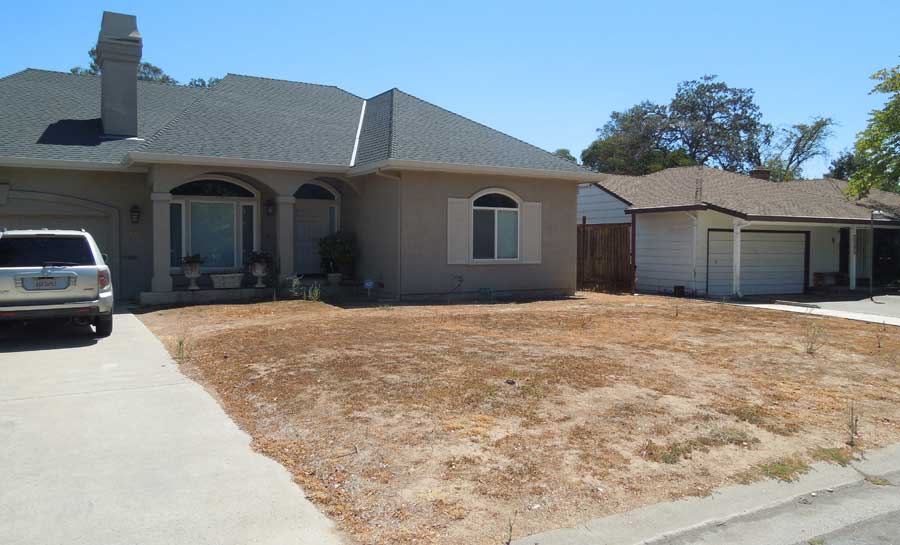
Limits the exception extended to certain HOAs that use recycled water from being able to fine homeowners for reducing or eliminating the watering of vegetation or lawns during government-declared drought periods. HOAs would be permitted to fine homeowners for eliminating watering of lawns during droughts provided that the homeowner’s property subject to the fine has previously received, and continues to receive, recycled water for landscaping irrigation.
Current Status: Chaptered
FindHOALaw Quick Summary:
Existing law prohibits an association from imposing a fine or assessment against a homeowner for reducing or eliminating the watering of vegetation or lawns during government-declared drought periods. That prohibition does not extend to an association that “uses recycled water…for landscaping irrigation.” (Civ. Code § 4735(c).)
AB 786 (Levine) would amend Civil Code Section 4735 to authorize the fining of an owner if the owner’s property has received, and continues to receive, recycled water for landscaping irrigation. This bill would incorporate additional changes to Section 4735 proposed by AB 349 (Gonzalez) that would become operative if this bill and AB 349 are enacted and this bill is enacted last. This bill would declare that it is to take effect as an emergency statute.
*UPDATE: AB 786 was signed into law on October 13, 2015 and its changes to the law took immediate effect.
View more info on AB 786from the California Legislature's website
Related Links
Failure to Enforce
An association has the duty to enforce the restrictions set forth in its CC&Rs. When it fails to do so, “a homeowner can sue the association for damages and an injunction to compel the association to enforce the provisions of the [CC&Rs].” (Posey v. Leavitt (1991) 229 Cal.App.3d 1236, 1246.) However, an association’s enforcement duty does not necessarily require its board of directors to litigate every violation of the association’s governing documents; the board is granted some discretion in determining whether or not to litigate any particular violation. (See “Duty to Enforce.”)
Relinquishment of Enforcement Rights
If an association’s board fails or refuses to enforce the restrictions, the association may ultimately lose its right and ability to enforce the restrictions based upon the following:
- Statute of Limitations – The statute of limitations for a violation of a restriction is five (5) years from the time the association “discovered or, through the exercise of reasonable diligence, should have discovered the violation.” (Code. Civ. Pro § 336(b).) The term “restriction” in this respect does not mean only those restrictions which are recorded in the CC&Rs; it also includes unrecorded restrictions such as architectural standards. (Pacific Hills HOA v. Prun (2008) 81 Cal.App.4th 1557, 1563-1564.)
- Laches – Laches is an equitable defense that is used against persons who are unjustifiably slow to exercise a right or claim. The defense of laches could be used to defeat an association’s enforcement action if an association unreasonably delays in exercising its enforcement rights and that delay results in prejudice to the violating homeowner. (Pacific Hills, at 431.)
- Waiver – “The right to enforce a restrictive covenant may be deemed generally waived when there are ‘a sufficient number of waivers so that the purpose of the general plan is undermined,’ in other words, when ‘substantially all of the landowners have acquiesced in a violation so as to indicate an abandonment.’” (Alfaro v. Community Housing Improvement System & Planning Assn. (2009) 171 Cal.App.4th 1356, 1380.)
Posey v. Leavitt
[Restrictions; Duty to Enforce] A homeowner has the right to sue the HOA to compel the HOA to uphold its duty to enforce the restrictions.
Iwasaki, Thomas & Sheffield and Bruce T. McIntosh for Plaintiff and Appellant.
Honey Kessler Amado for Defendants and Respondents.
OPINION
HOLLENHORST, J.
Plaintiff Posey, owner of a condominium at Lake Arrowhead, filed this action against Mr. and Mrs. Leavitt, owners of another condominium in the same development. Mr. Posey contended that the Leavitts built a deck extension on the side of their condominium that encroached the common area and obstructed his view. Mr. Posey also sued his condominium association for breach of fiduciary duty.
Certain issues were presented to the jury on special interrogatories, and the trial court entered a judgment in favor of the Leavitts and against Mr. Posey. However, the jury awarded Mr. Posey $30,000 damages against the association.
ISSUES
Mr. Posey appeals, contending that the trial court failed to rule on certain equitable issues and misconceived its duty in ruling on the claims for injunctive relief. Specifically, he contends that the trial court erred in submitting all legal and equitable issues to the jury, in failing to consider that the jury’s decision was only advisory on the equitable issues, in failing to make its own factual determinations, and in failing to issue a statement of decision. Secondly, he argues that the stipulation of the parties that the deck encroached on the common area should have led to findings of trespass and nuisance as a matter of law. He also contends that the Leavitts cannot rely on the board’s ratification of its consent to the deck construction. Mr. Posey also raises issues concerning jury instructions.
THE COMPLAINT
In order to understand Mr. Posey’s contentions, we first review the allegations of the complaint and the manner in which they were presented to [1241] the jury. The first three causes of action are against the Leavitts for wilful trespass, negligent trespass, and nuisance. For relief, plaintiff seeks an order requiring removal of the deck extension and damages.
The fourth cause of action is against the homeowners association for breach of fiduciary duty and breach of the covenant of good faith and fair dealing. In that cause of action, Mr. Posey contended that the association breached its fiduciary duties by approving the deck extension, and in not requiring its removal. He sought damages against the association.
TRIAL COURT PROCEEDINGS
At the beginning of trial, the Leavitts made a motion for judgment on the pleadings and argued that the court should decide whether a nuisance existed before submitting the damages issues to the jury.[FN.1] They urged that there was no nuisance and no trespass. The trial court did not deny the motion at that time, but stated that it felt that the case presented issues that should go to the jury. Subsequently, the trial court denied the motion on grounds that the pleadings stated sufficient causes of action to proceed.
The Leavitts’ counsel also moved at the beginning of the trial to bifurcate the trial so that the issue of nuisance would be first heard by the court. Although the trial court stated that it agreed that it would decide the nuisance issue, it denied the motion.
In his brief, Mr. Posey states that, at the time jury instructions were discussed, the trial court decided that it would not make a preliminary decision on the trespass and nuisance issues, but would submit these issues to the jury. Unfortunately, the court’s reasoning is unknown because this discussion was not reported.
The jury was asked to make 15 special findings. These questions included whether the board of the association had consented and/or ratified the deck improvement, whether the defendants had relied on the statements made to them, and whether the association had violated its fiduciary duties. Mr. Posey specifically objects to the asking of three questions: (1) “8) Was the use of Mr. and Mrs. LEAVITTS [sic] deck extension an interference, substantial and unreasonable, such as would be offensive to a normal person?” (The jury found it was not by a vote of 10-2); (2) “13) Did defendants, DAVID & AILEEN LEAVITT intentionally and willfully trespass on the `Common [1242] Area’?” (The jury found they did not by a vote of 11 to 1); and (3) “14) Did defendants David & Aileen Leavitt negligently trespass on the `Common Area’?” (The jury found they did not by a vote of 9 to 3.) The jury answered these questions as shown and found for the Leavitts generally.
Following the jury’s decision, a hearing was held on December 8, 1987, ostensibly on an equitable indemnity cross-complaint between the Leavitts and the association. At that time, the trial court also ruled on Mr. Posey’s request for injunctive relief, even though his counsel was absent. The court said: “I am prepared to rule on that. And my ruling would be that there is no injunctive relief. Based upon the jury’s finding and the jury’s verdict, there is no justification for any injunctive relief being granted by this court and would deny the plaintiffs’ request in that regard.”
At a subsequent hearing, Mr. Posey’s counsel sought to reargue the request for injunctive relief. The court granted his request, saying “I have to tell you that I’m probably a little bit predisposed in this matter because I had [previously ruled on the matter] and I don’t feel that I was inclined to violate the — or set aside the jury’s verdict as far as their opinion in order to grant any injunctive relief, but I’m willing to listen to your argument.” Mr. Posey’s counsel then requested that “the court try to set aside what it’s previously done and consider the points and authorities I’ve cited. [¶] THE COURT: I intend to do that.” Mr. Posey’s counsel then argued that his understanding was that the court would decide the equitable issues and that the jury would decide the damage claims against the association. Mr. Posey’s counsel argued that it was error for the trial court to submit the equitable issues to the jury, but that “I think that the appropriate thing for the court to do at this time is to consider the evidence that was presented in its own mind and make its own independent determination on the equitable issues involved.” He also argued that the jury was mistaken in the law if it concluded that the Leavitts’ reliance on the association’s alleged consent eliminated the trespass. He urged the court to correct the jury’s alleged mistake of law.
The Leavitts’ counsel responded that the jury was correct if it found that the consent of the association eliminated the trespass.
After further arguments on the merits of the issue, and the cross-complaint for implied indemnity against the association, the trial court said: “It will be under submission. [¶] I would only comment that, if the court really had any equitable power it could use, the best thing it could do would be to put the clock back to the Spring of 1981 and let all these things transpire over again. [¶] If there ever was a classic case of a no-win situation, this is also it.”
[1243] The trial court then issued its ruling on January 21, 1988. Characterizing the motion as a motion for reconsideration of the December 8, 1987, ruling, it denied reconsideration [FN.2] Six days later, the Leavitts filed a request for a statement of decision. Twelve days later, Mr. Posey filed a similar request. (1) (See fn. 3.) The trial court denied the requests as being untimely.[FN.3] Accordingly, we have no record of the reasons for the trial court’s decision other than the comments quoted above.
DISCUSSION
Plaintiff was plainly seeking equitable relief against the Leavitts in the form of an injunction to remove the encroachment. (2) Injunction is a remedy for the torts of trespass and nuisance. (See, generally, Code Civ. Proc., §§ 525, 526, 731; Civ. Code, § 3501; 5 Witkin, Summary of Cal. Law (9th ed. 1988) Torts, §§ 604, 607, pp. 704, 706; 11 Witkin, Summary of Cal. Law (9th ed. 1990) Equity, §§ 82, 121, 126, pp. 760-761, 802-803, 807-808; 5 Witkin, Cal. Procedure (3d ed. 1985) Pleading, §§ 773-774, pp. 217-219.) The Leavitts defended on grounds that the consent of the association eliminated any trespass or nuisance.
(3) “Nuisance is distinguishable from trespass in that the mere intentional entry on land may violate the right of exclusive possession and create a right of action for trespass, while conduct or activity cannot amount to a nuisance unless it substantially interferes with the use and enjoyment of the land.” (11 Witkin, Summary of Cal. Law, supra, Equity, § 125, p. 806.) (4) An action to abate a nuisance is an action in equity. (Meek v. DeLatour (1905) 2 Cal. App. 261, 263 [83 P. 300],disapproved on other grounds in Robinson v. Puls (1946) 28 Cal.2d 664, 666 [171 P.2d 430].)
(5) An encroachment is usually both a trespass and a nuisance. (11 Witkin, Summary of Cal. Law, supra, Equity, § 126, pp. 807-808.) The parties here stipulated that an expert witness would testify that all of the areas outside the buildings themselves, including decks and stairs, encroached [1244] on the common area. The issue of encroachment was therefore removed from the case, and did not need to be decided by the court or jury.
(6) Since the action was an equitable action, there was no right to a jury trial on the consent defense.[FN.4] (Wolford v. Thomas (1987) 190 Cal. App.3d 347, 353-354 [235 Cal. Rptr. 422]; Bank of America v. Greenbach (1950) 98 Cal. App.2d 220, 230 [219 P.2d 814].) (7) “Where a jury trial is not a matter of right, but is nonetheless permitted, the verdict rendered is advisory only. The court may accept or reject it, and, irrespective of the verdict, must make findings to complete the record.” (Estate of Kreher (1951) 107 Cal. App.2d 831, 837 [238 P.2d 150]; Estate of Cazaurang (1946) 75 Cal. App.2d 217, 225 [170 P.2d 694].) If there is no right to a jury trial, a party must file a motion to have any issues tried to the jury, but the jury’s decision is advisory. (Cal. Rules of Court, rules 230, 231.) While our record is incomplete on this issue, it is clear that plaintiff properly pointed out to the trial court that any error in submitting issues to the jury would be cured if the trial court adopted the jury’s findings as its own. (Whiting v. Squeglia (1924) 70 Cal. App. 108, 114 [232 P. 986].) Nevertheless, the trial court did not do so.
Here, the jury decided that the Leavitts did not obtain the required written consent of the board of directors at a meeting on June 25, 1981, but that the board subsequently ratified the deck construction and the chairman of the board led the Leavitts to reasonably believe they had board approval. Somewhat inconsistently, the jury then found that a subsequent letter by a member of the board ratified the prior acts of the board and constituted “a confirmation of `written consent.'”
Assuming that the jury found that consent had been given, and the trial court agreed, the legal question becomes whether the board had the power to consent to a trespass on the common area by a homeowner. The resolution of this question turns on the reconciliation of two different doctrines.
(8a) Mr. Posey contends that, under principles of real estate law, as applied by the condominium documents here, he was a tenant in common [1245] of the common area with the other homeowners, and he therefore had the right to directly enforce the equitable servitudes binding the homeowners. They primarily rely on Civil Code sections 1351 and 1354. Civil Code section 1351, subdivision (f) defines a condominium to consist “of an undivided interest in common in a portion of real property coupled with a separate interest in space called a unit….” Civil Code section 1354 states: “The covenants and restrictions in the declaration shall be enforceable equitable servitudes, unless unreasonable, and shall inure to the benefit of and bind all owners of separate interests in the development. Unless the declaration states otherwise, these servitudes may be enforced by any owner of a separate interest or by the association, or by both.”[FN.5]
The Leavitts contend that, under real estate and corporate law principles, the homeowner’s association owned the common area, and that the board of directors therefore had the power to sell, transfer, or, in this case, authorize an encroachment into the common area. The Leavitts point out that the developers deeded the common area (lot 56) directly to the homeowners association, a nonprofit corporation. They argue that the homeowners association was therefore the owner of the common area and it could consent to the encroachment.
The articles of the association empower it to “sell, lease, transfer, dedicate for public use or otherwise dispose of real or personal property in connection with the affairs of the Association.” The Leavitts contend that the power to sell must include the lesser power to consent to an encroachment.
The bylaws of the association give the board of directors the power to “exercise for the Association all powers, duties and authority vested in or delegated to this Association and not reserved to the membership by other provisions of these By-Laws, the Articles of Incorporation, or the Declaration.”
(9) (See fn. 6.) The declaration also contemplates ownership of the common area by the association, with the owners having easements over the common area.[FN.6] It therefore provides: “Every Owner shall have a right and [1246] easement of enjoinment [sic, enjoyment] in and to the Common Area which will be appurtenant to and shall pass title to every Lot….”[FN.7] The declaration also provides that the percentage of ownership of the common area shall not be changed without the consent of all of the owners.
(8b) The parties here focused on a section of the declaration which states: “No Owner shall, without first obtaining written consent of the Board, make or permit to be made any structural alteration or structural improvement in or to his Lot or in or to any other part of the Project. No Owner shall take any action or permit any action to be taken that will impair the structural soundness or integrity or safety or [sic, of] any building or other structure in the Project or impair any easement or right or personal property which is a part of the Project, without the written consent of all Owners.” The Leavitts argued that, having obtained the written consent required by the first sentence, their project met the requirements of the declaration, even though it was not approved by the other homeowners.
We disagree for two reasons. Under the second sentence, an encroachment into the common area impairs the easements of the other owners over the common area, and thus requires the consent of all of the homeowners.[FN.8]
Secondly, although the Leavitts contended that board approval was sufficient because the board owns the common area, it is not necessary that the plaintiff own the property. All plaintiff needed to do was to show a possessory right superior to the right of the trespassers. (5 Witkin, Cal. Procedure, supra, Pleading, §§ 582, 586, pp. 48-49, 51-52.) Plaintiff clearly had such a right here.[FN.9]
(10a) Under well-accepted principles of condominium law, a homeowner can sue the association for damages and an injunction to compel the association to enforce the provisions of the declaration. (Cohen v. Kite Hill Community Assn. (1983) 142 Cal. App.3d 642 [191 Cal. Rptr. 209].) (8c) More importantly here, the homeowner can sue directly to enforce the declaration. “The typical declaration provides that the association or any owner has the right to enforce the declaration by any proceeding at law or in equity…. Ordinarily the declaration would be enforced by the association. However, in the event of that body’s failure or inability to act because of divergence of opinion among the members, any one of the unit/lot owners may take legal action to enforce the restrictions against what he considers to be a violation by one or more other unit/lot owners.” (Hanna, Cal. Condominium Handbook (2d ed. 1986) § 14.58, p. 430.)[FN.10]
(10b) “Any owner who believes that the association is not discharging its duty to enforce the restrictions has an individual cause of action against the association and the person who has violated the restrictions….” (7 Miller & Starr, Cal. Real Estate,supra, § 20:58, pp. 128-131; 4 Witkin, Summary of Cal. Law (9th ed. 1988) § 495, pp. 672-673.)
(8d) We therefore conclude that the trial court should have initially decided at least the trespass cause of action in favor of the plaintiff, and that, since the consent of the board of directors was insufficient authorization for the encroachment, the trial court should not have submitted any issues to the jury. The parties initially viewed the jury as the fact-finder on the damage claims against the association. If it had been limited to this role, the trial would have been substantially shortened and error avoided.
(11) Despite this conclusion, we do not find that Mr. Posey should automatically receive the injunction he seeks. As the Leavitts point out, theirs is a small encroachment and the governing principles were long ago summarized in Christensen v. Tucker (1952) 114 Cal. App.2d 554 [250 P.2d 660]: “It is our view that the better reasoned cases hold that in encroachment cases the trier of fact possesses some discretion in determining whether to grant or to deny the mandatory injunction. In exercising that discretion, and in weighing the relative hardships, the court should consider various factors. It starts with the premise that defendant is a wrongdoer, and that plaintiff’s property has been occupied. Thus, doubtful cases should be decided in favor of the plaintiff. In order to deny the injunction, certain factors must be present: 1. Defendant must be innocent — the encroachment must not be the result of defendant’s willful act, and perhaps not the result [1248] of defendant’s negligence. In this same connection the court should weigh plaintiff’s conduct to ascertain if he is in any way responsible for the situation. 2. If plaintiff will suffer irreparable injury by the encroachment, the injunction should be granted regardless of the injury to defendant, except, perhaps, where the rights of the public will be adversely affected. 3. The hardship to defendant by the granting of the injunction must be greatly disproportionate to the hardship caused plaintiff by the continuance of the encroachment and this fact must clearly appear in the evidence and must be proved by the defendant. But where these factors exist, the injunction should be denied, otherwise, the court would lend itself to what practically amounts to extortion.” (Id., at pp. 562-563; see, generally, 4 Witkin, Summary of Cal. Law, supra,Real Property, § 426, pp. 608-609; 11 Witkin, Summary of Cal. Law, supra, Equity, §§ 153-158, pp. 833-840): “Even the early California cases recognized the defense of balancing conveniences where the nuisance consisted of a slight encroachment of buildings on adjoining property.” (11 Witkin, supra, at p. 835.)
After citing this rule, defendants apply it to the facts of this case and conclude that the trial court properly denied injunctive relief. Thus, they contend that they acted in good faith and in reliance on the consent given them by the board of directors of the association.[FN.11] Secondly, they argue that Mr. Posey will not sustain any irreparable harm if the deck extension is not removed, particularly since he has no enforceable right to a view. Third, they contend that the hardship and cost to them from a removal of the deck extension outweighs the insignificant obstruction of Mr. Posey’s view if the deck extension remains.
The problem with defendants’ argument is that, while the trial court could have made these determinations in their favor, it did not.[FN.12] The trial court’s comments quoted above show that it did not decide the case under its equitable jurisdiction, did not independently evaluate the evidence, did not specifically adopt the jury’s findings, and did not weigh the relative hardships to decide whether to grant or deny the injunction. Even the cases defendants cite to support their position also support the proposition that [1249] the case will be reversed and remanded if the trial court has failed to weigh the relative hardships and make proper findings. (Brown Derby Hollywood Corp. v. Hatton, supra, 61 Cal.2d 855; D’Andrea v. Pringle (1966) 243 Cal. App.2d 689 [52 Cal. Rptr. 606]; Christensen v. Tucker, supra, 114 Cal. App.2d 554.)
(12) Anticipating this problem, defendants rest on the presumption in favor of the validity of a judgment and contend that a correct decision should be upheld even if it is based on the wrong reasons.[FN.13] They argue that the judgment is valid on its face, and, since there was no statement of decision, it will be presumed that the trial court found all facts necessary to support the judgment, citing In re Marriage of Ditto(1988) 206 Cal. App.3d 643 [253 Cal. Rptr. 770].
We reject this argument for two reasons. First, unlike Ditto, we have found that the trial court was properly asked for a statement of decision and failed to give it. Second, the judgment here contains the special findings of the jury quoted above, but no reasons for the denial of equitable relief. Because of the inconsistencies in the findings, we cannot presume that the judgment is regular. Since the trial court’s comments quoted above indicate that the trial court did not exercise its discretion, we cannot presume that it did.
Since the trial court failed to exercise its discretion in this regard, the case must be remanded to allow it to do so. However, for its guidance, we briefly discuss some of the other issues raised by the parties, and their effect on the trial court’s future deliberations. (See, generally, 5 Miller & Starr, Cal. Real Estate, supra, § 14:13, pp. 328-334.)
- Alleged Right to a View.
(13) In applying the Christensen test, the trial court will generally grant the injunction if it finds that the plaintiff will suffer irreparable injury from the encroachment. To decide whether the plaintiff here will suffer irreparable injury, the trial court must decide the threshold question of whether plaintiff had a right to his view.
Generally, there is no such right. Venuto v. Owens-Corning Fiberglas Corp. (1971) 22 Cal. App.3d 116 [99 Cal. Rptr. 350], states the general rule: “Although, in the light of the foregoing principles, it would appear that an interference with the view from land may amount to a nuisance, the courts have held that a building or structure cannot be complained of as a nuisance [1250] merely because it obstructs the view from neighboring property.” (Id., at pp. 126-127.) The jury was correctly, although unnecessarily, instructed here that, under California law, a landowner has no right to an unobstructed view over adjoining property. (See, also, Wolford v. Thomas, supra,190 Cal. App.3d 347; Pacifica Homeowners’ Assn. v. Wesley Palms Retirement Community (1986) 178 Cal. App.3d 1147, 1152 [224 Cal. Rptr. 380]; Katcher v.Home S. & L. Assn. (1966) 245 Cal. App.2d 425 [53 Cal. Rptr. 923].)
“As a general rule, a landowner has no natural right to air, light or an unobstructed view and the law is reluctant to imply such a right. [Citations.] Such a right may be created by private parties through the granting of an easement [citations] or through the adoption of conditions, covenants and restrictions … or by the Legislature [citations].” (Pacifica Homeowners’ Assn. v. Wesley Palms Retirement Community, supra, 178 Cal. App.3d 1147, 1152, italics added.)
The declaration here does not contain a specific provision giving homeowners a right to existing views. It is also true that, as defendants pointed out at oral argument, the courts are reluctant to imply such a right. Nevertheless, the practical effect of enforcing the provisions of the declaration would be to give protection to plaintiff’s existing view.
For example, plaintiff relied on general language in the declaration to support his contention that a right to a view could be found in the declaration. He pointed out that the declaration refers to an easement of “enjoinment,” which is presumably intended to be the right of quiet enjoyment stated in Civil Code section 1463. (See, generally, Petroleum Collections Inc. v. Swords (1975) 48 Cal. App.3d 841 [122 Cal. Rptr. 114].) Such a right is a running covenant, enforceable as an equitable servitude. (Civ. Code, § 1462; Cal. Condominium and Planned Development Practice (Cont.Ed.Bar 1984) §§ 1.9, pp. 15-16, 8.42-8.44, pp. 666-668.) The declaration also requires owners to adhere to the rules of the association. These rules require the common area to remain unobstructed, and the effect of strictly enforcing the right of quiet enjoyment or these rules would be to remove the alleged obstruction to plaintiff’s view.
On the other hand, as defendants point out, the declaration allows any owner to use the common area “in accordance with the purposes for which it is intended, so long as he does not hinder or encroach upon the lawful rights of the other Owners.” (Declaration, par. 6, pp. 7-8.) Defendants argue that, since a view is not generally a “lawful right,” plaintiff’s only right is the right to be free from an unreasonable interference with the use and enjoyment of his property. Although the jury found no such unreasonable [1251] interference here, the trial court could find that the encroachment itself was an unreasonable interference with the intended uses of the common area.
Accordingly, in determining whether plaintiff has suffered irreparable injury, the trial court should not consider deprivation of a view, per se, as an injury. It should, however, consider the total effect of the encroachment and specifically whether it constitutes an unreasonable interference with plaintiff’s rights under the declaration and rules. In interpreting the documents, the trial court should apply a rule of liberal interpretation to facilitate the operation of the development. (Civ. Code, § 1370; 7 Miller & Starr, Cal. Real Estate, supra, § 20:57, pp. 126-128.)
If the trial court finds that the defendants are innocent and that plaintiff will not suffer irreparable injury, the court should then proceed with evaluating the relative hardships under the third prong of the Christensen test. (Christensen v. Tucker, supra, 114 Cal. App.2d 554.) The considerations discussed in this section would also apply in balancing the relative hardships.
- Interference With Use.
(14) In considering irreparable injury and relative hardships, the trial court should not consider the Leavitts’ use of the deck extension.
Defendants contend that there is no nuisance because the jury found that the use of the deck extension by the Leavitts was not “an interference, substantial and unreasonable, such as would be offensive to a normal person.” Thus, they cite cases such as Venuto v. Owens-Corning Fiberglas Corp., supra, 22 Cal. App.3d 116, 126-127, which discuss the noninvasive activities that may constitute a nuisance. Venuto states: “Under the law of nuisances, where personal discomfort is the basis of the complaint the test of liability is the effect of the alleged interference on the comfort of normal persons of ordinary sensibilities in the community.” (Id., at p. 126.) However, these cases are not applicable here because this is not a case of noninvasive activities that constitute a nuisance. The encroachment is an obstruction to the free use of the common area, and is itself the nuisance. (Civ. Code, § 3479; 11 Witkin, Summary of Cal. law, supra, Equity, § 156, pp. 835-837.) The trial court therefore need not consider whether the Leavitts’ use of the deck extension interfered with the Mr. Posey’s use of his deck in applying the balancing test.
- Effect of Prior Award of Money Damages.
(15) The trial court can consider injunctive relief despite the fact that the jury awarded Mr. Posey money damages against the association.
[1252] Defendants contend that the trial court cannot award injunctive relief because Mr. Posey was awarded money damages against the association. They argue that the damages were for the diminishment in value of the Posey property, and that, having been awarded such damages, Mr. Posey cannot obtain injunctive relief.
We disagree. The cause of action against the association was for breach of fiduciary duty. (Cf. Frances T. v. Village Green Owners Assn. (1986) 42 Cal.3d 490, 513-514 [229 Cal. Rptr. 456, 723 P.2d 573, 59 A.L.R.4th 447].) Although Mr. Posey claimed a diminishment in value of approximately $50,000, it is not clear that damages were awarded for that diminishment. The jury may well have awarded the $30,000 to Mr. Posey, payable by the association, to compensate him for the costs of bringing an action that the association should have brought. Damages were the legal remedy for the breach of fiduciary duty, while injunctive relief was the equitable remedy sought for the trespass and nuisance. (Rest.2d, Torts, § 822, com. d.) Defendants’ argument also fails because Code of Civil Procedure section 731 allows a plaintiff to both enjoin or abate a nuisance and also recover damages. The trial court remains free, on remand, to issue the requested injunction, to award damages in lieu of an injunction, or to find for defendants.
DISPOSITION
The judgment is reversed and the case is remanded with instructions to the trial court to exercise its discretion to decide whether or not to issue an injunction by applying the tests stated in Christensen v. Tucker, supra, 114 Cal. App.2d 554. In making this determination, the trial court should consider whether or not the encroachment by the Leavitts was innocently made, whether Mr. Posey will suffer irreparable injury if the injunction is not issued, and the relative hardships to the parties caused by granting or denying the injunction. The trial court should also make and enter a statement of decision in accordance with Code of Civil Procedure section 632. Plaintiff is to recover costs on appeal.
Dabney, Acting P.J., and McKinster, J., concurred.
[FN. 1] The record is not complete because the trial briefs and written motions were not included in the record. The transcript indicates that the parties and the court generally accepted the principle that the trial court would decide the trespass and nuisance issues, and the jury would determine monetary damages.
[FN. 2] Defendants correctly note that plaintiff then filed an improper notice of appeal dated March 18, 1988, from the minute order instead of the judgment. Defendants properly moved to augment the record to include the judgment filed July 25, 1988, and suggest that we must treat the appeal as timely filed pursuant to California Rules of Court, rule 2(c). While such treatment is discretionary, not mandatory, we agree with defendants that we should consider the appeal on its merits. We note, however, that the perfection of the appeal, including obtaining the judgment and including it in the record on appeal, is properly the burden of the appellant, not the respondent.
[FN. 3] The trial court apparently counted the time from its earlier decision in December, despite its statement that it would set aside its previous decision and consider the matter over again. While there is some question as to the timeliness of the plaintiff’s request in February, the Leavitts’ request was clearly filed in time. The trial court therefore erred in denying the request for a statement of decision. (Code Civ. Proc., § 632.)
[FN. 4] The action could also be construed as an action for the recovery of real property, i.e., an ejectment action. If so, factual issues raised by the consent defense would be properly triable by the jury: “In actions for the recovery of … real … property, with or without damages, … an issue of fact must be tried by a jury, unless a jury trial is waived, or a reference is ordered, as provided in this Code. Where in these cases there are issues both of law and fact, the issue of law must be first disposed of.” (Code Civ. Proc., § 592.) In our view, the action was essentially a trespass action, and the third sentence of section 592 applies: “In other cases, issues of fact must be tried by the Court, subject to its power to order any such issue to be tried by a jury….” Since the action against the Leavitts was essentially equitable, the jury’s findings were only advisory.
[FN. 5] The declaration here was recorded in 1973. At that time, similar language was contained in former Civil Code section 1355. In 1985, the statutes were reorganized by the Davis-Stirling Common Interest Development Act (Stats. 1985, ch. 874) and the quoted language was adopted.
[FN. 6] It also inconsistently provides that “Each Owner shall own an undivided interest in the Common Area, including Limited Common Area. No such percentage shall be altered without the consent of all Owners….” Plaintiff, as a member of the association, either owned the common area as a tenant in common with the other homeowners or owned the easement interest discussed in the text. (Civ. Code, § 1351, subd. (l); former Civ. Code, § 1353, subd. (b).) Either interest is sufficient to support his trespass action. (See, generally, 7 Miller & Starr, Cal. Real Estate (2d ed. 1990) § 20:51, p. 117; 5 Miller & Starr, Cal. Real Estate, supra, § 14.10, pp. 323-325.)
[FN. 7] Interestingly enough, this section also provides that the easement is subject to the right of the association to convey the common area to a public agency but that such a conveyance requires a 2/3 vote of the owners. The declaration fails to mention the general right to transfer real property which is contained in the articles of incorporation, and which is unrestricted.
[FN. 8] The declaration also provides that “each Owner may use the Common Area, excepting Limited Common Area, in accordance with the purposes for which it is intended, so long as he does not hinder or encroach upon the lawful rights of the other Owners.” Obviously, as the parties agreed, there was an encroachment here.
[FN. 9] An analogous situation would be where a landlord consents to a third person’s activities on the property that interfere with a tenant’s interests. The tenant can still sue the third person for trespass on the tenant’s estate. (Brown Derby Hollywood Corp. v. Hatton (1964) 61 Cal.2d 855, 858; 5 Miller & Starr, Cal. Real Estate, supra, § 14.10, pp. 323-325.)
[FN. 10] The declaration here provides that: “Each Owner shall comply strictly with the provisions of this Declaration, and the Rules as the same may be lawfully amended from time to time, and with decisions adopted pursuant to said Declaration and Rules, and failure to comply shall be grounds for an action to recover reasonable sums due for damages or for injunctive relief, or both, maintainable by the Board or Manager in behalf of the Owners, or in a proper case, by an aggrieved Owner. …” (Italics added.)
[FN. 11] At oral argument, defendants also argued that there was a past practice of the board approving deck extensions, and that this history was relevant in interpreting the contract created by the recorded declaration. However, the defendants failed to point out that the declaration contains a waiver clause which essentially provides that the failure to insist on strict performance of a provision of the declaration is not a waiver of that provision. (Declaration, par. 15, pp. 18-19.)
[FN. 12] Defendants also rely on the familiar rule that the exercise of the trial court’s discretion will be reversed only upon a showing of abuse of discretion. Again, the problem for defendants is that the record does not show that the trial court did exercise its discretion or did adopt the findings of the jury as its own. (Cf. Lippold v. Hart (1969) 274 Cal. App.2d 24 [78 Cal. Rptr. 833].)
[FN. 13] The most recent case relied on by defendants, Novicke v. Vons Grocery Store (Cal. App.) has been ordered depublished by the Supreme Court.
Rancho Sante Fe Association v. Dolan-King
[Architectural Control; Architectural Standards] A HOA’s architectural standards could be used to define undefined architectural restrictions/terms contained in the CC&Rs.
Law Offices of Robert R. Massey and Robert R. Massey for Defendant and Appellant.
Musick, Peeler & Garrett, Michael J. Hickman; Lucas, Mullany, Boyer & Haverkamp and Richard L. Boyer for Plaintiff and Respondent.
OPINION
HUFFMAN, Acting P. J.-
Patricia Dolan-King, a homeowner in the residential community of Rancho Santa Fe, is the defendant and appellant in this action to enforce a protective covenant, brought by the Rancho Santa Fe Association (the Association). The Association obtained judgment in its favor for injunctive and declaratory relief and an award of attorney fees, based on Dolan-King’s construction of a fence around her property without the appropriate permits or compliance with other Association regulatory criteria for the definition of “major” or “minor” construction. Dolan-King appeals, contending that the trial court erred in directing a partial verdict on the validity of certain land use regulations enforced by the Association, and that the jury verdict resulting after the partial directed verdict is unsupported by the evidence or the law. She also contends that attorney fees should not have been awarded. (Civ. Code, § 1354, subd. (f).) fn. 1
Our examination of the record leads us to conclude that the trial court was correct in finding the challenged Rancho Santa Fe Regulatory Code provisions (the regulatory code) are valid, concerning the definition of the terms major and minor construction, and the subsequent jury verdict is supported by the evidence. We affirm the judgment and order of attorney fees to the Association as the prevailing party.
FACTUAL AND PROCEDURAL BACKGROUND
In 1996, Dolan-King purchased a home on an approximately three-acre lot in Rancho Santa Fe, located at 6840 El Camino Del Norte. Property development in Rancho Santa Fe is subject to the Rancho Santa Fe Protective[33]Covenant (Covenant), adopted and recorded in 1928 and amended at various times over the years. At the time she purchased her property, there was an original three-rail corral-type fence on it. Dolan-King originally proposed extensive remodeling plans (room addition structures) and a reconstructed fence composed of stucco columns joined by horizontal wood beams, and sought the appropriate permits from the Association. The Association reviewed those plans and denied permission to proceed with them. The story of that land use application and its processing by the Association is told in a published opinion, Dolan-King v. Rancho Santa Fe Assn.(2000) 81 Cal.App.4th 965 (referred to as our prior opinion or “Dolan-King I“).
In that prior action, Dolan-King had sought a judicial determination of the validity and enforceability of certain unrecorded guidelines, which provided the criteria and restrictions used by the art jury of the Association to reject her applications as to both the room additions and the proposed fence project. (Dolan-King I, supra,81 Cal.App.4th at p. 973.) Although Dolan-King had prevailed at trial, on appeal, the Association obtained reversal of that judgment. This court concluded that “the relevant provisions of the protective covenant are enforceable equitable servitudes, and, with regard to Dolan-King’s improvement applications, Dolan-King failed to meet her burden to show the Board’s decisions were unreasonable and arbitrary under the circumstances.” (Id. at p. 970.)
While that appeal was pending, Dolan-King caused to be constructed around the perimeter of her property a wrought iron fence approximately five feet in height and 800 feet long, with posts approximately every eight feet. She testified at trial that under her interpretation of paragraph 48 of the Covenant, she thought that this fence constituted minor construction, pursuant to the following Covenant definition: “The building of fences, walls, and similar structures, are divided into two classes: First, major construction; second, minor construction.The property owner may proceed with what he definitely thinks is a minor construction without submitting plansand specifications to the Art Jury as provided above, subject to the continuing jurisdiction of the Association through its Board of Directors to hear complaints against said minor construction . . . .” (Emphasis added.)
The Association, through its manager, sent her a letter June 3, 1999 informing her this fence was major construction under the regulatory code, section 31.0302, and that she should seek a permit or tear down the fence, or be subject to the imposition of a $500 lien for noncompliance with Covenant provisions and the revocation of her privileges to use Association facilities.
When she did not seek a permit or tear down the fence, the Association sent her a notice that a hearing would be held August 5, 1999 before the[34]Board regarding the revoking of her privileges to use Association facilities and the imposition of the $500 assessment. (The lien was released shortly before trial.) That hearing was held and those actions were taken by the Board. The minutes of the Board meetings state that the fence being discussed was not the one involved in the prior litigation, such that there was any approval of it pending that appeal.
The Association then brought this action for injunctive and declaratory relief to have Dolan-King seek the proper permits or remove the fence. Attorney fees were sought under section 1354. She responded with her cross-complaint for breach of contract, breach of fiduciary duty, slander of title, and related relief.
At trial call, various motions in limine were submitted and rulings made. As relevant here, the trial court refused Dolan-King’s offer of proof to provide traffic and safety evidence about the traffic in the area of her property as it pertains to fencing.
At the outset of trial, Dolan-King’s attorney agreed with the trial court that the validity of the regulatory code was subject to a ruling on its validity as a matter of law, based upon the governing documents of the Association. He argued that the Association had exceeded its powers by enacting the portions of the regulatory code dealing with major or minor construction, in contravention of paragraph 48 of the Covenant. Subsequently, the trial court rendered a statement of decision rejecting this argument and upholding the validity of the pertinent provisions of the regulatory code. This resulted in the entry of a partial directed verdict in favor of the Association. In its order, the court explained its reasoning as follows: Based on the relevant documentary evidence associated with this matter and the argument by the parties, the court found that the fence erected on the Dolan-King’s property was “major construction” as that term is used in the Covenant and the regulatory code. Specifically:
“Paragraph 48 of the Rancho Santa Fe Protective Covenant provides:
The building of fences, walls, and similar structures, are divided into two classes: First, major construction; second, minor construction. The property owner may proceed with what he definitely thinks is a minor construction without submitting plans and specifications to the Art Jury as provided above, subject to the continuing jurisdiction of the Association through its Board of Directors to hear complaints against said minor construction and to hear, try and determine the said complaints upon due notice to the defending property owner. Tennis courts and swimming pools are major construction.”
The order continued, “Section 31.0301 of the Rancho Santa Fe Regulatory Code provides: Fences and Walls. All fences and walls shall constitute ‘Major[35]Construction.'” (Although the court clearly intended to cite the fence and wall provisions, it erroneously cited to section 31.0301 in this respect; the actual language involved is not disputed and we may properly cite these provisions as shown in the record, section 31.0302.) The trial court then referred to section 31.0302.01 as specifying that “Wooden split-rail fences not exceeding 36″ in height, and consisting of two or fewer rails, and which observe all set-back requirements established for structures in the Protective Covenant, shall be considered minor construction.”
The trial court then concluded that pursuant to paragraph 48 of the Covenant and section 31.0302.01 of the regulatory code, “the only fence which constitutes ‘minor construction’ is a wood pasture rail fence with two rails, 36″ or less in height. Based on the Court’s review of the evidence and interpretation of Paragraph 48 of the Rancho Santa Fe Protective Covenant in conjunction with Sections 31.0302 and 31.0302.01 of the Rancho Santa Fe Regulatory Code, the subject fence constructed by defendant Patricia Dolan-King constituted ‘major construction.'”
The remaining issues of the complaint and cross-complaint, concerning compliance with the Covenant, were then submitted to the jury. It heard testimony and evidence about the Association’s procedures used to respond to the building of this wrought iron fence, and Dolan-King’s own testimony and expert testimony to support her belief that the fence constituted minor construction. Dolan-King also presented evidence that another landowner (Cloverlane Associates) had received a hearing in 2001 pursuant to paragraph 48 of the Covenant, when objections to a fence it built were raised. She argues that she had been subject to disparate treatment, because the Cloverlane fence issues had been dealt with more formally.
After deliberations, the jury returned a verdict in favor of the Association, finding it had not breached the Covenant provisions as alleged, and against Dolan-King on her cross-complaint. The special verdict provided that the cross-complaint was dismissed, and:
“2. The fence erected by defendant on or about Memorial Day 1999 (‘Subject Fence’) is ‘major construction’ within the meaning of that term in the Rancho Santa Fe Protective Covenant (‘Covenant’) and the Rancho Santa Fe Regulatory Code (‘Regulatory Code’).
“3. The Subject Fence could not be constructed consistent with the Covenant and the Regulatory Code without first obtaining a permit from the Rancho Santa Fe Association in accordance with the procedures set forth in the Covenant and the Regulatory Code.
“4. The Subject Fence was constructed without obtaining a permit from the Rancho Santa Fe Association.[36]
“5. The construction of the Subject Fence without a permit was a violation of the Covenant.
“6. The Subject Fence remains on the property of defendant Patricia Dolan-King as of the date of the jury verdict herein.
“7. In order to comply with the Covenant, defendant Patricia Dolan-King must remove the Subject Fence.”
At further proceedings, the Association submitted a proposed form of judgment in the alternative, that Dolan-King should seek the appropriate permits or remove the fence. She objected that an alternative form of judgment was inappropriate. The judgment signed by the trial court ordered that she was “permanently enjoined from maintaining the Subject Fence on the ‘Property’ . . . . To that end, defendant Patricia Dolan-King is enjoined and ordered to remove the Subject Fence from the Property within 30 days of the date of entry of this Judgment.”
In subsequent proceedings, the Association’s motion for attorney fees was granted in the amount of $318,293.50. The ruling stated that “the overall average hourly rate for the Association’s attorneys in the amount of $221 is reasonable in light of the nature of the litigation, the difficulty of the litigation, the skill required and employed by the Association’s attorneys, and the success of the Association in this litigation.” Also, an award of fees was included to reflect the amount of $12,007 for paralegal time, as necessary for the support of the Association’s attorneys.
Dolan-King appeals the judgment and order.
DISCUSSION
We first discuss the partial directed verdict which upheld the validity of the challenged regulatory code provisions, in light of the standards set out in prior litigation arising under this Covenant. (Pts. I & II, post.) We will then turn to Dolan-King’s arguments that the application of these regulations was unreasonable, as reflected in the jury verdict. We also evaluate the judgment in terms of the injunctive relief ordered and the attorney fees ordered. (Pt. III, post.)
I. APPLICABLE STANDARDS GLEANED FROM PRIOR LITIGATION
Much of the groundwork for this appeal has been laid by our prior opinion, Dolan-King I, which dealt with the validity of parallel provisions enacted by[37]the Association, the unrecorded guidelines followed by the Association’s art jury. Here, the issues concern the unrecorded regulatory code, but much of the same basic analysis is appropriate, as we next explain.
First, however, we must acknowledge the guidance provided by another prior opinion issued by this court, Ticor Title Insurance Co. v. Rancho Santa Fe Assn.(1986) 177 Cal.App.3d 726 (Ticor Title). This case established the principle that the Association’s power to “interpret” the Covenant does not grant its board any power to enact more stringent specific regulations than those expressly contained in the Covenant (e.g., setback regulations), unless appropriate amendment procedures have been followed as set forth in the Covenant: “The power to interpret, however, is not unlimited. The Board’s construction of its interpretation powers leads to an extraordinary and unjust result. Under this construction, the Board is unlimited in its power to interpret the Covenant as it sees fit even if, as in the instant case, it involves ignoring express language in the Covenant and denigrating the voting rights of the property owners. We do not believe the covenanting parties intended the Board to have such unfettered powers by the process of ‘interpretation.'” (Id. at pp. 733-734.)
Also in Ticor Title, supra, 177 Cal.App.3d 726, this court rejected the Association’s argument that because paragraph 14 granted authority to the Association to adopt regulations for the “general welfare,” a more extensive action, such as “a change or modification of existing provisions in the Covenant,” could be accomplished outside of the amendment provisions set forth in the Covenant, paragraph 165. In that case, the setback restriction was not one of the basic restrictions contained in the Covenant, and hence the amendment provisions of paragraph 165 applied. (In our case, a basic restriction found in paragraph 48 is involved, hence the amendment provisions of paragraph 164 would apply if an “amendment, change, modification or termination” of a restriction is to be accomplished, by a required two-thirds vote of property owners.) Dolan-King is claiming the limits outlined inTicor Titleon the Association’s power were exceeded when the Board adopted and enforced these portions of the regulatory code.
In order to examine this argument, we turn to the extensive guidance provided by the Supreme Court regarding the standards that apply in evaluating the validity of the challenged land use regulations, in this context of a governing land use covenant and subsequent, related regulations. In Lamden v. La Jolla Shores Clubdominium Homeowners Assn. (1999) 21 Cal.4th 249, 264 (Lamden), the Supreme Court discussed its prior opinion, Nahrstedt v. Lakeside Village Condominium Assn. (1994) 8 Cal.4th 361 (Nahrstedt), which set forth the general rule, “When an association determines that a [38] unit owner has violated a use restriction, the association must do so in good faith, not in an arbitrary or capricious manner, and its enforcement procedures must be fair and applied uniformly.” (Id.at p. 383.) Restrictions found in a governing land use covenant “are evaluated for reasonableness in light of ‘the restriction’s effect on the project as a whole,’ not from the perspective of the individual homeowner. [Citations.] Accordingly, courts do not conduct a case-by-case analysis of the restrictions to determine the effect on an individual homeowner; we must consider the reasonableness of the restrictions by looking at the goals and concerns of the entire development.” (Dolan-King I, supra, 81 Cal.App.4th at p. 975.)
To expand upon the nature of the various rules that may be used to create use restrictions in such developments, the Supreme Court sought in Lamden, supra,to clarify the “distinction between originating CC&R’s and subsequently promulgated use restrictions. Specifically, we reasoned in Nahrstedt that giving deference to a development’s originating CC&R’s ‘protects the general expectations of condominium owners “that restrictions in place at the time they purchase their units will be enforceable.”‘ [Citations.] Thus, our conclusion that judicial review of a common interest development’s founding CC&R’s should proceed under a deferential standard was, as plaintiff points out, at least partly derived from our understanding . . . that the factors justifying such deference will not necessarily be present when a court considers subsequent, unrecorded community association board decisions.” (Lamden, supra, 21 Cal.4th at p. 264.)
Accordingly, in Dolan-King I, this court applied the rules developed in Nahrstedt, supra,8 Cal.4th 361 and Lamden, supra,21 Cal.4th 249, to such “subsequently promulgated use restrictions” that have not been recorded as running with the land. (Id.at p. 264.) In Dolan-King I, this court was concerned with the unrecorded guidelines followed by the Association’s art jury, as opposed to here, the issues concerning the unrecorded regulatory code. In either case, “such unrecorded restrictions are not accorded a presumption of reasonableness, but are viewed under a straight reasonableness test ‘so as to “somewhat fetter the discretion of the board of directors.”‘ [Citations.] We understand this distinction to primarily impact the respective burdens of proof at trial.” (Dolan-King I, supra, 81 Cal.App.4th at p. 977.) fn. 2[39]
Before we examine the decision of the trial court to uphold the validity of the subject regulatory code provisions dealing with major versus minor construction, as applied to fence work, it is useful to compare the nature of the guidelines analyzed in Dolan-King Ito the regulations at issue here. We noted previously that “[t]he Guidelines themselves do not purport to be strict restrictions on improvements or land use. They are intended to ‘disseminate[] the site and design standards which the community holds as necessary to preserve community character; articulate[] the policies and goals by which the Association judges and regulates land use; and give[] a clear indication of those site and design principles which increase the probability of the issuance of Association permits.'” (Dolan-King I, supra, 81 Cal.App.4th at p. 978.) Accordingly, even though the guidelines were not formalized as recorded equitable servitudes, we found there was “nothing inherently unreasonable about the Guidelines in and of themselves. They are the Association’s attempt to give property owners guidance, by way of detailed examples and explanation, on the criteria used by the Art Jury and Board in reviewing proposed improvements and exercising their broad discretion under the Covenant. The Board’s desire to give property owners more concrete examples of how the Art Jury is likely to exercise its broad discretion is entirely legitimate and fair, even though the Guidelines are not binding restrictions. That Dolan-King lacked notice of the Guidelines does not affect their reasonableness, but may influence our determination of whether the Board fairly and reasonably relied upon them to deny Dolan-King’s fence application . . . .” (Ibid.)
In this case, by comparison, section 31.03 of the regulatory code provides examples of various structures, improvements and grading that substantially affect community character and that therefore are deemed to constitute major construction. Section 31.0302 generally provides, “All fences and walls shall constitute “Major Construction.” However, section 31.0302.01 of the code specifically provides: “Exception: Split-Rail Fences. Wooden, unpainted split-rail fences not exceeding 36″ in height, and consisting of two or fewer rails shall be considered minor construction.” Another exception is provided for, i.e., garden walls that do not exceed 32 inches in height and that are composed of dry-laid materials, and which observe all set-back requirements established for structures in the protective Covenant, are considered to be minor construction. (§ 31.0302.02 of the regulatory code.)
For all practical purposes, the regulatory code is similar to the guidelines with respect to its unrecorded character, but its undisputed availability to interested Association homeowners for purposes of putting them on notice of the standards to be applied in evaluating development proposals. [1] The same straight reasonableness test should be applied to the code as to the guidelines, with attention to whether any basic restrictions of the Covenant are actually amended, changed, modified or terminated by the code, within the meaning of the amendment provisions of paragraph 164. The question[40]here is whether the code accomplishes such a substantive amendment, etc., of basic restrictions, as opposed to defining any terms left undefined by the Covenant, such as major and minor construction. (Para. 48.)
II. VALIDITY OF REGULATIONS: PARTIAL DIRECTED VERDICT
Following the above-described approach, we examine the trial court’s grant of the partial directed verdict upholding the subject regulatory code provisions to decide if the court correctly applied the “straight reasonableness test [designed] ‘to “somewhat fetter the discretion of the board of directors.”‘ [Citations.]” (Dolan-King I, supra, 81 Cal.App.4th at p. 977.) Where, as here, the decisive underlying facts (the nature of the fence and the actions taken by the Association), are undisputed, then the validity of the subject regulatory code provisions may be decided as a matter of law: “In such a case, in reviewing the propriety of the trial court’s decision, we are confronted with questions of law. [Citations.] Moreover, to the extent our review of the court’s declaratory judgment involves an interpretation of the Covenant’s provisions, that too is a question of law we address de novo.” (Dolan-King I, supra, 81 Cal.App.4th 965, 974.)
Dolan-King challenges the ruling in the Association’s favor chiefly by contending that the regulatory code effectively modifies, changes, or amends the controlling Covenant provision, paragraph 48, but without the necessary compliance with paragraph 164, to submit the matter to a vote of homeowners. She is arguing that the Covenant expressly protects a subjective right of the property owner to have a belief that a subject fence is minor construction, and to act accordingly by having it installed without the need for any permits or Association approval. (“The building of fences, walls, and similar structures, are divided into two classes: First, major construction; second, minor construction. The property owner may proceed with what he definitely thinks is a minor construction without submitting plans and specifications to the Art Jury as provided above, subject to the continuing jurisdiction of the Association through its Board of Directors to hear complaints against said minor construction . . . .” (Para. 48, emphasis added.)) Although paragraph 49 provides a procedure for the homeowner to submit plans to the art jury in case there is doubt about whether the contemplated work is a major or minor construction, she had no such doubt.
Further, Dolan-King argues that the powers of the Association and its board under the Covenant are primarily limited to promoting the general welfare of the community, and that this power should not allow aesthetic[41]considerations to override safety and traffic control considerations. (Para. 14.) She contends that the trial court erroneously read the Association’s articles of incorporation and bylaws, together with the Covenant language, as allowing the code to define these terms with such specificity, when paragraph 48 of the Covenant is more general in nature.
The Association is granted the power in its governing documents to adopt regulations. The articles of incorporation, article II, section 1, and the bylaws, article IV, section 6(e) allow regulations to be enacted as authorized by the Covenant and the articles of incorporation and bylaws. Paragraph 37 of the Covenant gives the Association regulatory power to carry out the provisions of the Covenant and governing documents. Paragraph 14 of the Covenant authorizes the Association to adopt rules and regulations promoting the health, safety and general welfare of the residents.
The fallacy of Dolan-King’s argument is that it focuses mainly upon her subjective beliefs as a homeowner, while failing to account for the well-accepted power of an association operating under the land use covenant to clarify and define its terms, so long as it is operating within the straight reasonableness standard. Both as to the governing Covenant and subsequently enacted restrictions, the inquiry should be whether their provisions are reasonable “in light of ‘the restriction’s effect on the project as a whole,’ not from the perspective of the individual homeowner. [Citations.] Accordingly, courts do not conduct a case-by-case analysis of the restrictions to determine the effect on an individual homeowner; we must consider the reasonableness of the restrictions by looking at the goals and concerns of the entire development.” (Dolan-King I, supra, 81 Cal.App.4th at p. 975.)
We disagree with Dolan-King that sections 31.03 et seq. effectively amend or modify paragraph 48 of the Covenant. Rather, these code sections operate to define the terms major and minor construction, with respect to fencing. They preserve the right of a homeowner to proceed with minor construction without seeking permits, while permissibly defining the parameters of what should reasonably be considered minor construction. The Covenant section is properly subject to objective clarification of its terms, which are not defined in that document. [2] It is not unreasonable for the Association to refer to the historical nature of low-lying split rail fences in the area as minor construction, thus preserving that category of the Covenant definition, while defining other types of fencing as major construction. So long as some fences may still constitute minor construction, the Covenant provision referring to minor construction has not been substantively modified or amended, changed, or terminated by this regulatory code. (Para. 164.)
Moreover, paragraph 48 itself reserves power to the Association, through its board of directors, “to hear complaints against said minor construction and[42]to hear, try and determine the said complaints upon due notice to the defending property owner,” even when the property owner proceeded with what he definitely thought was “minor construction,” without submitting plans and specifications. (Ibid.) This presupposes Association control to some extent over the definitions of those terms. Also, paragraph 49 provides a procedure for the homeowner to submit plans to the art jury in case there is doubt about whether the contemplated work is major or minor construction. [3] Based upon this reserved power in the Association to hear, try and determine complaints about any construction, it is not unreasonable for the Association and its board to enact regulations that seek to define such terms as minor construction in order to give notice to homeowners of readily discoverable, objective standards for interpretation of the Covenant. The trial court correctly granted the partial directed verdict on this basis.
Because Dolan-King is primarily relying upon her subjective understanding of what constitutes minor construction, the main thrust of her challenge to the regulatory code is found in the application of those provisions to her, in an allegedly unreasonable manner. We now turn to those arguments.
III. APPLICATION OF REGULATIONS AT TRIAL: JURY VERDICT
Dolan-King has two main challenges to the jury verdict in the Association’s favor that determined it had not breached the terms of the Covenant through its dealings with her fence construction. She first argues that even assuming the regulatory code is valid, as discussed above, the evidence nevertheless demonstrates that the Association did not follow its own procedures in dealing with her construction, and she was subject to disparate treatment in light of the more specifically referenced hearing that the Cloverlane Associates homeowners received, concerning paragraph 48. Thus, she claims the Association waived its right to enforce these regulations and they are unreasonable as applied to her.
Alternatively, she appears to be arguing that the trial court erroneously excluded her evidence about traffic and safety concerns surrounding her property, and that the judgment should be reversed because she was not allowed to fully present her case that this was minor construction. She mainly relies on case authority as follows: “‘A judgment may not be reversed on appeal, . . . unless “after an examination of the entire cause, including the evidence,” it appears the error caused a “miscarriage of justice.” [Citation.] . . . [W]here the error results in denial of a fair hearing, the error is reversible[43]per se. Denying a party the right to testify or to offer evidence is reversible per se. [Citations.]'” (Kelly v. New West Federal Savings (1996) 49 Cal.App.4th 659, 677.)
A. Reasonableness Of Procedures
[4] Because this issue was resolved upon disputed evidence, including challenges to the credibility of the Association witnesses, a substantial evidence standard of review should apply. (Toigo v. Town of Ross (1999) 70 Cal.App.4th 309, 317.) We accordingly disagree with appellant that this portion of the analysis must be conducted de novo, as pure documentary interpretation, in light of the parties’ submission to the jury of disputed facts. (See Davies Machinery Co. v. Pine Mountain Club Inc. (1974) 39 Cal.App.3d 18, 23.)
[5] In ruling for the Association, the trial court impliedly made findings that the letters that the Association sent to Dolan-King in June 1999 referred to the regulatory code and therefore gave her adequate notice that a hearing would be held regarding whether there was noncompliance with the Covenant building restrictions and related regulations, and whether her membership privileges should be suspended and a lien recorded against her property as a consequence. It was not disputed that the only basis that existed for considering the suspension of her membership privileges was the subject fence construction without appropriate permits.
Dolan-King argues that proper procedures were not followed, because the record does not contain any homeowner complaints against her, as contemplated by paragraph 48 of the Covenant, and that therefore the Association should not have proceeded to enforce the regulatory code. However, the trial court could reasonably conclude that the June 3, 1999 [6] Association manager’s letter referring to the code and notifying her of her noncompliance constituted a “complaint” within the Covenant definitions. [7] The trial court also determined that the notice given of the upcoming hearing was appropriate, even though the Association did not label the proposed hearing to be one held specifically under paragraph 48. Again, this was a reasonable interpretation of the documentary evidence. When Dolan-King was notified that a hearing would be held August 5, 1999 before the Board regarding the revoking of her privileges to use Association facilities and the imposition of a $500 lien assessment, she had already been placed on notice that the stated basis of that proposed action was noncompliance with the Covenant regarding the subject fence. Accordingly, the fact that the hearing was not labeled to be a proceeding under paragraph 48 was not dispositive. Dolan-King failed to make any convincing showing that the Association’s dealings with her in[44]1999 in that manner were measurably unfair when compared to the Association’s dealings in 2001 with another homeowner, Cloverlane, whose fence construction was opposed as not in compliance with Covenant standards, and where paragraph 48 was more expressly invoked.
The record also demonstrates that the subject fence was constructed while an appeal was pending from the earlier judgment arising from the original application for a fence permit and its denial, and that Dolan-King was knowledgeable about permit requirements for fences and had the advice of an attorney on the subject. She clearly understood the distinction between her original application to build the fence, and her claim that no application was necessary to build this fence. Accordingly, she has failed to show any impropriety in the notice and hearing given on the minor construction issue.
Dolan-King’s backup position is that under any definition, the fence she built should be considered minor construction, because it was installed in a few days, was of relatively low cost, and was of a type that was relatively easy to install and remove. However, she has not shown that these criteria necessarily led to an objective conclusion that this fence was minor construction. The trial court had in evidence photographs and measurements about the subject fence and the original fence it replaced, along with testimony presented by Dolan-King’s construction expert that some definitions were necessary as to major and minor construction, because those terms were not universally used one way or the other in the construction industry. It was not a foregone conclusion that only minor construction was involved here, when all the evidence was considered.
On the whole record, we cannot say that the trial court erred in deciding that the Association had not breached the Covenant through its utilization of the complaint and hearing procedure, nor had it waived its right to enforce these regulations. Dolan-King failed to show that she met any accepted standards about what was minor construction of a fence, such that any different result was required.
B. Fairness of Trial Proceedings
To evaluate the claims that the traffic and safety evidence was erroneously excluded, we refer to well-established authority that “an appellate court applies the abuse of discretion standard of review to any ruling by a trial [45] court on the admissibility of evidence. [Citations.] Speaking more particularly, it examines for abuse of discretion a decision on admissibility that turns on the relevance of the evidence in question. [Citations.] That is because it so examines the underlying determination as to relevance itself. [Citation.] Evidence is relevant if it has any tendency in reason to prove a disputed material fact. [Citation.]” (People v. Waidla (2000) 22 Cal.4th 690, 717.)
Dolan-King’s argument in this respect appears to be a claim that there should be a traffic and safety exception to the requirement that a permit be obtained for other than minor construction. She bases this argument upon public policy concerns, such as a right to privacy and to protect her home and family, and a theory that the burden of these regulations outweighs any benefit that is received from them.
While these arguments are appealing in the abstract, we cannot say that Dolan-King’s efforts to present this evidence had any support in the language of the Covenant, its subsequently enacted regulations, or the Association’s governing documents, in light of our conclusions above that the validity of the regulatory code could be addressed as a question of law, as agreed to in the trial proceedings. [8] There is no express traffic or safety exception to the permit requirement. The Covenant includes concerns about the general welfare of the homeowners in the area, and the Association is given regulatory powers to promote them. [9] Moreover, the same traffic concerns were addressed in the previous litigation that lead to the Dolan-King I opinion, and the trial court here was of the belief that to allow traffic evidence to be introduced would be to retry that previous case. Under all the circumstances, we can find no abuse of discretion in the in limine rulings that excluded traffic and safety evidence about this particular property.
Finally, although Dolan-King now argues there was no adequate showing of irreparable harm to the Association to support the issuance of injunctive relief, she cannot be heard to complain about the form of relief ordered. This is because she objected to an alternative form of judgment, which would have allowed her to apply for a permit for the fence, or tear it down. The fence had been in place approximately three years by the time of trial, and she had never sought a permit due to her argument that none was required for minor construction. [10] Once that issue was determined against her, and based upon her objection to allowing the permit procedure to be further pursued, any error in the issuance of the injunctive relief was either invited error or harmless. (7 Witkin, Cal. Procedure (4th ed. 1997) Judgment, § 22, p. 558.)[46]
On the record before us, we cannot find Dolan-King showed that the Association’s procedures as applied to her were unreasonable, nor that the trial proceedings were unfair.
IV. ATTORNEY FEE AWARD
Dolan-King appeals the trial court’s order granting an award of attorney fees to the Association under section 1354, subdivision (f). The order authorized an award in the amount of $318,293.50, based on an overall average hourly rate for the Association’s attorneys in the amount of $221, and an award for paralegal time.
Although Dolan-King has provided a copy of the order, she has not provided the moving and opposing papers on the fees matter. The only argument made in the opening brief is that this large award will have a chilling effect on discouraging legitimate opposition to the Association’s business practices, which she labels as questionable. (Blue Lagoon Community Association v. Mitchell (1997) 55 Cal.App.4th 472, 476-478.)
The party seeking to challenge an order on appeal has the burden to provide an adequate record to assess error. (Maria P. v. Riles (1987) 43 Cal.3d 1281, 1295-1296.) Where the party fails to furnish an adequate record of the challenged proceedings, his claim on appeal must be resolved against him. (Ibid.; also see Ketchum v. Moses(2001) 24 Cal.4th 1122, 1140-1141.)
[11] Ordinarily, an award of attorney fees under a statutory provision, such as section 1354, subdivision (f), is reviewed for abuse of discretion. The Association remains the prevailing party here. We have been presented with no support for Dolan-King’s claims of abuse of discretion with respect to the time expended, the hourly rate billed, or the nature of the costs assessed after the motion to tax was ruled upon. Accordingly, the proper course is to uphold the award. (Vo v. Las Virgenes Municipal Water District(2000) 79 Cal.App.4th 440, 447.) The respondent’s brief does not seek an award of attorney fees on appeal. The ordinary costs on appeal will be awarded to the Association, however.[47]
DISPOSITION
The judgment and order are affirmed. Costs on appeal to the Association.
Nares, J., and O’Rourke, J., concurred.
FN 1. All further statutory references are to the Civil Code unless noted.
FN 2. The Supreme Court has granted review in a case further examining the standards which govern the validity of a land use restriction in a common interest development, i.e., one that was adopted and recorded by an association after the purchase of the unit in the development. (Villa de Las Palmas Homeowners Association v. Terifaj, review granted Sept. 25, 2002, S109123.) That case is fully briefed but has not been set for oral argument. It is factually distinguishable because the challenged regulations in our case are unrecorded (the regulatory code).
Bear Creek Planning Committee v. Ferwerda
[Architectural Control; Architectural Standards] A HOA had the authority to adopt architectural standards beyond those set forth in the CC&Rs based upon empowering language in the CC&Rs governing the same.
Thomas & Associates and Michael W. Thomas for Appellant Robert Ferwerda.
Law Offices of Samuel G. Grader, Christian B. Green; Porter & Simon, James E. Simon; Lewis Brisbois Bisgaard & Smith, Jeffry A. Miller, Judith M. Tishkoff and Matthew B. Stucky for Respondent Bear Creek Planning Committee.
Porter Scott, Timothy M. Blaine and John F. Doyle for Respondents David Bordon, Richard E. Irving, Peter M. Turner, Irene Wertheim, Ronald Scoglio, Carole Lynn Keller and Bear Creek Valley Board.
Louis A. Basile for Respondents James Ware and Cindy Ware.
CERTIFIED FOR PARTIAL PUBLICATION[FN *]
OPINION
ROBIE, J.—
This appeal follows a trial by reference[FN. 1] of three consolidated cases. The trial court entered judgment against plaintiff Robert Ferwerda, who had been trying to build a home on his vacant lot. He had sued the Bear Creek Planning Committee (the committee) and the individuals who comprised the Bear Creek Valley Board (the board) who he contended inappropriately blocked construction on his lot. He had also sued his next-door neighbors, James and Cindy Ware (the Wares), contending they had violated the covenants, conditions, and restrictions (CC&R’s) in building and remodeling their house. Ferwerda appeals from a judgment entered in favor of the committee, the board, and the Wares, which included awards of attorney fees to the committee and the Wares. We affirm the judgment as to the committee and the Wares, except as it relates to the attorney fees. As to those orders, we reverse. Finally, as to the board, we dismiss as moot the appeal relating to it.
[1181] FACTUAL AND PROCEDURAL BACKGROUND
A. Introduction
Robert Ferwerda owns lot No. 134 in Alpine Meadows Estates subdivision unit No. 4 (subdivision No. 4). Since 2001, he has been trying to obtain approval to build a house on his lot. This litigation surrounds events related to securing that approval, interpretation of the CC&R’s and related restrictions on the lots in subdivision No. 4, and the resolution of the three cases consolidated in the trial court.
B. The CC&R’s, the Green Book, and the 2002 Architectural Review Manual
The CC&R’s that govern subdivision No. 4 were recorded in 1964 and establish “a general plan for the improvement and development” of the property. The guiding principle is “that it is to the best interest of the area that it be developed into an attractive ski area, alpine in character and appearance, with as little damage to the natural beauty of the land and trees as is possible.” To that end, the CC&R’s contain several restrictions on the subdivision. Among other things, owners are not permitted to cut down trees over five inches in diameter on their lots without approval from the committee. More generally, owners are required to receive approval from the committee before constructing or excavating on their lots. The owners’ plans and specifications and the committee’s approval must be “in accordance with the procedures and standards set forth in the Bear Creek Planning Committee Restrictions.” The “Bear Creek Planning Committee Restrictions” were incorporated into the CC&R’s as exhibit A in 1964.
The committee incorporated in 1978. The articles of incorporation describe the committee’s primary purpose as “promoting the social welfare of the community of Alpine Meadows, California and for the mutual benefit of all property owners in that community through supervision and enforcement of the [CC&R’s].” Among its powers and duties as articulated in its bylaws are “[t]o review and approve or disapprove plans and specifications for improvements in the Bear Creek Valley pursuant to the CC&R’s,” “conduct, manage and control the affairs of the corporation and to make such rules and regulations thereof as they may deem appropriate,” and “maintain, issue, and revise at its discretion” a procedures, regulations, and standards manual.
[1182] In 1990, the committee published the so-called green book that contains procedures, regulations, and standards. The “green book” notes the observance of objective criteria for plan approval and of subjective criteria guided by a proposed plan’s “harmony with the environment in which the structure is placed and harmony with its surroundings.” The restriction on tree removal is continued. It recommends use of fire-retardant composition shingles. Finally, it includes the following attorney fees provision: “In the event that it is necessary for the Committee to initiate litigation to enforce the provisions of these Provisions, Regulations, and Standards, then the Committee shall be entitled to recover its reasonable attorneys’ fees and costs.”
The green book was revised in 2002 and that revision became known as the 2002 architectural review manual. The manual states, among other things, “[t]he design of each structure must bear a harmonious relationship to the land and its neighbors” and live trees cannot be removed without board approval. Similar to the green book, it contains the following attorney fees provision: “In the event that it is necessary for the [committee] to enforce the provisions of the [2002 architectural review manual] by obtaining legal advice to clarify issues, initiate litigation, filing and/or preparing legal documents or filing and preparing a Cease and Desist Order, then [the committee] shall be entitled to recover its reasonable attorney fees and costs from the Performance Deposit or other means as may be deemed necessary. Legal expenses above the performance deposit may be recovered by fines assessed.”
C. Ferwerda’s Activities and Resulting Litigation[*]
DISCUSSION
I
The Committee Has the Power to Adopt Standards Beyond Those Set Forth in the CC&R’s
Section 6 of the CC&R’s states the committee may act on applications, “all in accordance with the procedures and standards set forth in the Bear Creek Planning Committee Restrictions, a copy of which is attached hereto as [1184] Exhibit A and by this reference is made a part hereof. Except as to set-backs (Paragraph 13 hereof),in the event of a conflict between the standards required by said Committee and those contained herein, the standards of said Committee shall govern.” (Italics added.)
The trial court found this italicized language “empowers the [committee] to adopt new conditions on an ongoing basis.” As we explain below on our de novo review (Ekstrom v. Marquesa at Monarch Beach Homeowners Assn. (2008) 168 Cal.App.4th 1111, 1121 [86 Cal.Rptr.3d 145]), the trial court was correct to the extent this language allows the committee to adopt new design standards related to the improvement or development of lots in subdivision No. 4.
(1) The interpretation of CC&R’s is governed by the rules for interpreting contracts. (Fourth La Costa Condominium Owners Assn. v. Seith (2008) 159 Cal.App.4th 563, 575 [71 Cal.Rptr.3d 299].) (2) It is a long-standing rule that “[a]ll parts of a [contract] must be applied so as to give effect and meaning to every part, if possible . . . .” (Burnett v. Piercy (1906) 149 Cal. 178, 189 [86 P. 603]; see Civ. Code, § 1641 [“[t]he whole of a contract is to be taken together, so as to give effect to every part, if reasonably practicable, each clause helping to interpret the other”].)
(3) The plain language of section 6 of the CC&R’s contemplates the committee may adopt standards beyond those contained in exhibit A as it existed when the CC&R’s were adopted. This is evidenced by the acknowledgment in section 6 that if there is a conflict between the standards set forth in that section and the “standards required by [the] [c]ommittee,” the standards of the committee govern. If the committee had no power to adopt standards beyond those in the CC&R’s, there would be no need for this language. We must read the CC&R’s as a whole and adopt the construction that gives effect to every part of the CC&R’s. (Ezer v. Fuchsloch (1979) 99 Cal.App.3d 849, 861 [160 Cal.Rptr. 486] [“[a] cardinal principle of document construction is that a document must be `construed as a whole’ so as `to give effect to every part thereof . . .'”].)
The question then becomes what is meant by “standards” as that term is used in the CC&R’s. That term is used in section 6 in reference to the “procedures and standards set forth in the Bear Creek Planning Committee Restrictions” that are attached to the CC&R’s. In those restrictions, there is a “standards” section. The first paragraph entitled, “GENERAL” explains in part that “[t]he design of each structure must bear a harmonious relationship to the land and its neighbors, in terms of lot coverage, mass and degree of individual expression.” The remaining 13 paragraphs (with the exception of the last one, which addresses variances) detail architectural design standards, [1184] i.e., standards for such things as floorspace, decks, roofs, exterior walls, windows, colors and finishes, and parking places. In the context of the CC&R’s, then, the term “standards” refers to architectural design standards.
Ferwerda offers no interpretation of this language in section 6 of the CC&R’s. Instead, he points to case law and testimony from the committee’s expert witness, which he claims negate our interpretation of the CC&R’s. Neither helps him.
The cases relied on by Ferwerda, Werner v. Graham (1919) 181 Cal. 174 [183 P. 945] and Riley v. Bear Creek Planning Committee (1976) 17 Cal.3d 500 [131 Cal.Rptr. 381, 551 P.2d 1213], are distinguishable.
In Werner, a developer subdivided a tract and recorded a map of the tract that “showed no building lines or anything else to indicate any purpose of restricting in any way . . . .” (Werner v. Graham, supra, 181 Cal. at p. 177.) He then sold the lots. (Id. at pp. 177-178.) The early deeds contained “restrictive provisions” that were “so uniform and consistent in character as to indicate unmistakably that [the developer] had in mind a general and common plan which he was following.” (Id. at p. 177.) The developer told the purchasers, “he was exacting the same restrictive provisions from all purchasers.” (Id. at pp. 178-179.) The developer later quitclaimed the property eventually purchased by the plaintiff, but the deed to this property contained no restrictions. (Id. at p. 179.) The court held restrictions placed in the earlier deeds to the other properties were not binding on the plaintiff. (Id. at pp. 184-186.)
In Riley, the developer sold a property via a deed that contained no restrictions. (Riley v. Bear Creek Planning Committee, supra, 17 Cal.3d at pp. 503-504.) Nine months later, the developer recorded a document purporting to impose uniform restrictions on a number of lots, including the one in dispute. (Id. at p. 504.) The court held these restrictions did not apply to the lot sold earlier. (Id. at pp. 506-507.)
Both of these cases are distinguishable because the CC&R’s here specifically acknowledge the possibility of a conflict between the standards set forth therein and the “standards required by [the] [c]ommittee” and assert that if such a conflict arises, the standards required by the committee govern. Ferwerda signed that he “read and approved” the CC&R’s.
The expert testimony to which Ferwerda points also does not help him. That testimony consisted of the opinion of the committee’s expert that section 6 does not expressly authorize the committee to create new or different standards than those attached in exhibit A (as other CC&R’s he had worked [1185] on did) but that by implication, the committee had such authority. This testimony undercuts Ferwerda’s position because it supports a reading of section 6 (if only by implication) that gives the committee such authority.
Based on the plain language of section 6 of the CC&R’s, we hold the committee had the power to adopt standards beyond those set forth in the CC&R’s, which are reflected in the green book and the 2002 architectural review manual.
II
The Trial Court Erred in Awarding Attorney Fees to the Committee and to the Wares
Ferwerda contends the court erred in requiring him to pay the committee’s and the Wares’ attorney fees. In his view, the green book and the 2002 architectural review manual cannot be the bases for authorizing the attorney fees because they are unrecorded and were enacted by an unelected committee without approval of the property owners.
The committee and the Wares take the position adopted by the trial court, i.e., the attorney fees were permissible because the green book and the 2002 architectural review manual provide for the recovery of attorney fees for prevailing parties such as themselves. And, in any event, Ferwerda asked for attorney fees if he prevailed and since he lost in the trial court, he was liable for the other side’s attorney fees.
(4) A prevailing party is entitled to attorney fees when authorized by statute or contract. (Code Civ. Proc., §§ 1032, 1033.5, subd. (a)(10).) Here, the CC&R’s contain no attorney fees provision. Rather, the green book and the 2002 architectural review manual provide for recovery of attorney fees by the committee. In reviewing these publications in part I of the Discussion, we explained that the CC&R’s give the committee power to adopt new design standards relating to the improvement or development of lots in subdivision No. 4. The question is whether that power allows the committee to adopt attorney fees provisions not contained in the CC&R’s.
The committee contends it had such broad power because the CC&R’s and its own bylaws give it the authority to “expand upon and describe the provisions of the CC&Rs” and “[s]o long as such rules and guidelines are reasonable and do not conflict with the CC&R’s, they will be held to be enforceable.” In support, they cite MaJor v. Miraverde Homeowners Assn. (1992) 7 Cal.App.4th 618 [9 Cal.Rptr.2d 237] and Rancho Santa Fe Assn. v. [1186] Dolan-King (2004) 115 Cal.App.4th 28 [8 Cal.Rptr.3d 614] (Rancho Santa Fe). Neither case helps the committee.
In MaJor, the court addressed whether the homeowners association was authorized to discriminate between resident members and nonresident members in the use and enjoyment of common areas. (MaJor v. Miraverde Homeowners Assn., supra, 7 Cal.App.4th at p. 625.) The CC&R’s granted every member a right and easement of enjoyment in and to the common areas within the property, subject only to the right of the association to establish uniform rules and regulations pertaining to a member’s use of the common areas and recreational facilities. (Ibid.) Nonresident members asserted the association acted without authority in restricting the use of common areas by nonresident members. (Ibid.) The court agreed, explaining as follows: “an association may not exceed the authority granted to it by the CC&R’s. Where the association exceeds its scope of authority, any rule or decision resulting from such an ultra vires act is invalid whether or not it is a `reasonable’ response to a particular circumstance. Where a circumstance arises which is not adequately covered by the CC&R’s, the remedy is to amend the CC&R’s. The courts have held homeowners are subject to any reasonable amendment of the CC&R’s properly adopted . . . .” (Id.at p. 628.)
In Rancho Santa Fe, the court addressed whether a homeowners association could apply a regulation adopted subsequent to the enactment of land use covenants that clarified the terms of one of those covenants permitting a homeowner to undertake “minor” (as opposed to “major”) construction without the art jury’s approval. (Rancho Santa Fe, supra, 115 Cal.App.4th at p. 40.) In holding the association could, the court explained the governing documents granted to the association power to adopt regulations and further explained an association operating under a land use covenant had the “well-accepted power” to clarify and define the covenant’s terms, so long as it did so reasonably. (Id. at p. 41.)
These cases do not support the authority of the committee to enact the attorney fees provisions here. In MaJor, the court limited the association’s authority to that granted to it in the CC&R’s. It is not enough, as the committee argues, that the attorney fees provisions are reasonable. MaJor rejected this argument, noting that if a circumstance arises that is not adequately covered by the CC&R’s, the remedy is to amend the CC&R’s, regardless of whether the association’s actions are reasonable. (MaJor v. Miraverde Homeowners Assn., supra, 7 Cal.App.4th at p. 628.) Here, the CC&R’s are silent on attorney fees. It is a situation, therefore, “not adequately covered by the CC&R’s,” requiring amendment of the CC&R’s to insert such a provision. (Ibid.) Similarly, in Rancho Santa Fe, the court’s holding that the regulation was enforceable turned on the fact the governing [1187] documents granted the association power to adopt regulations and the fact the at-issue regulation served only to reasonably clarify terms already in the land use covenant. (Rancho Santa Fe, supra, 115 Cal.App.4th at p. 41.) Here, the attorney fees provisions do not seek to clarify existing language in the CC&R’s. Rather, they are an attempt by the committee to insert a new provision that binds homeowners without their approval.
Undaunted, the committee continues to argue that the CC&R’s, the green book, and the 2002 architectural review manual “must be construed together as one contract, as the rules and standards in the Greenbook and [the 2002 architectural review manual] give effect to the CC&Rs.” In support, it cites Huntington Landmark Adult Community Assn. v. Ross (1989) 213 Cal.App.3d 1012 [261 Cal.Rptr. 875].) There, the defendants challenged an attorney fees award, contending there was no provision for attorney fees in the CC&R’s. (Id. at p. 1023.) The court held the defendants were “mistaken” because the supplemental declaration of easements, covenants, conditions and restrictions contained an attorney fees provision. (Ibid.) Huntington is unhelpful here. To the extent the green book and the 2002 architectural review manual deal with topics already covered by the CC&R’s and simply serve to reasonably clarify their meaning (see Rancho Santa Fe, supra, 115 Cal.App.4th at p. 41) or to the extent they adopt new or different standards (which as we have explained in pt. I of the Discussion the CC&R’s give the committee the power to do), those documents are a legitimate exercise of the committee’s power granted to it under the CC&R’s. They therefore bind the homeowners whether we view them as separate or supplemental to the CC&R’s. The same reasoning does not apply to the attorney fees provisions. Nothing in the CC&R’s gives the committee the power to insert into the green book and the 2002 architectural review manual an attorney fees provision that was never in the CC&R’s or contemplated therein. Huntington simply does not cover this situation.
We turn then to the other basis on which the committee and the Wares seek to uphold the attorney fees awards: Ferwerda asked for attorney fees if he prevailed and since he lost in the trial court, he was liable for the other side’s attorney fees. The problem with this argument is that it relies on an incomplete statement of the law.
(5) Pursuant to Civil Code section 1717, “a prevailing party is entitled to attorney fees only if it can prove it would have been liable for attorney fees had the opponent prevailed.” (M. Perez Co., Inc. v. Base Camp Condominiums Assn. No. One (2003) 111 Cal.App.4th 456, 467 [3 Cal.Rptr.3d 563].) In Perez, we disapproved dictum in our earlier opinion in International Billing Services, Inc. v. Emigh (2000) 84 Cal.App.4th 1175 [101 Cal.Rptr.2d 532], which said, “Where a party claims a contract allows fees and prevails, it gets [1188] fees. Where it claims a contract allows fees and loses, it must pay fees.” (International Billing Services, at p. 1190.) We explained in Perez: “The fallacy of the rule stated in International Billing Servicesis the assumption that if the party who claims that a contract allows fees prevails in the underlying litigation, it gets attorney fees. In truth, the party must still prove that the contract allows attorney fees. The mere allegation is not enough.” (Perez, at p. 468.) The same applies for a losing plaintiff. For a losing plaintiff to be required to pay attorney fees, the plaintiff’s “bare allegation that [h]e is entitled to receive attorney’s fees [is] not . . . sufficient”; he also had to have established the attorney fees clauses “actually entitled” him to recover fees. (Leach v. Home Savings & Loan Assn. (1986) 185 Cal.App.3d 1295, 1307 [230 Cal.Rptr. 553].) Here, Ferwerda never so established, and as we have explained, he could not so establish because the attorney fees provisions in the green book and the 2002 architectural manual did not legitimately serve to add an attorney fees provision to the CC&R’s.[FN. 2] Therefore, the committee and the Wares could not claim the right to attorney fees simply because Ferwerda had asked for those fees in his complaint.[FN. 3]
(6) In sum, there was no basis, either contractual or statutory on which to award attorney fees to the committee or the Wares.[FN. 4] The fees awards must be reversed.
III-VI[FN *]
[1189] DISPOSITION
The orders for attorney fees are reversed. In all other respects, the judgment as to the committee and the Wares is affirmed. The appeal as to the board is dismissed. The board is entitled to its costs on appeal. (Cal. Rules of Court, rule 8.278(a)(1), (2).) Ferwerda, the committee, and the Wares shall bear their own costs on appeal. (Cal. Rules of Court, rule 8.278(a)(3).)
The stay issued by this court on December 29, 2010, is vacated upon finality of this opinion.
Nicholson, Acting P. J., and Butz, J., concurred.
[*] Pursuant to California Rules of Court, rule 8.1110, this opinion is certified for publication with the exception of part C of the Factual and Procedural Background and parts III, IV, V, and VI of the Discussion.
[1] A trial by reference is a proceeding under Code of Civil Procedure section 638, subdivision (a), which provides that a referee may be appointed by agreement of the parties to “hear and determine any or all of the issues in an action or proceeding, whether of fact or of law, and to report a statement of decision.” That “statement of decision . . . is the equivalent of a statement of decision rendered by a superior court under Code of Civil Procedure section 632.” (Central Valley General Hospital v. Smith (2008) 162 Cal.App.4th 501, 513 [75 Cal.Rptr.3d 771].) As such, a referee’s statement of decision is subject to appellate review using the same rules that apply to a trial court’s statement of decision. (Ibid.) For simplicity, here we refer to the referee as the trial court.
[*] See footnote, ante, page 1178.
[2] Ferwerda also claimed attorney fees under the private attorney general fee statute (Code Civ. Proc., § 1021.5) in his first amended cross-complaint. The provisions of Civil Code section 1717 are distinct from and have no application to the private attorney general fee statute. Section 1717’s right to attorney fees is based on the notion of reciprocal contractual attorney fees.
[3] We note also the attorney fees provisions in the green book and the 2002 architectural review manual were unilateral, in favor of the committee. “Section 1717 of the Civil Code, however, which governs enforcement of contractual attorney fees provisions, provides that any contractual attorney fees provision must be applied mutually and equally to all parties to the contract, even if it is written otherwise.” (Scott Co. v. Blount, Inc. (1999) 20 Cal.4th 1103, 1106 [86 Cal.Rptr.2d 614, 979 P.2d 974].)
[4] The above analysis applies to the Wares’ claims of attorney fees as well. The Wares’ argument that they are entitled to attorney fees is based on the attorney fees provision in the green book, which they claim Ferwerda relied upon throughout the litigation here. Whether that is true is irrelevant. Because we hold the committee had no power to insert the attorney fee provision into the green book, the Wares cannot rely on that provision to claim they are entitled to attorney fees.
[*] See footnote, ante, page 1178.